
Trade surplus 'to decrease more' in 2011
By Ding Qingfen and Wang Xiaotian (China Daily)
Updated: 2011-03-08 07:27

|
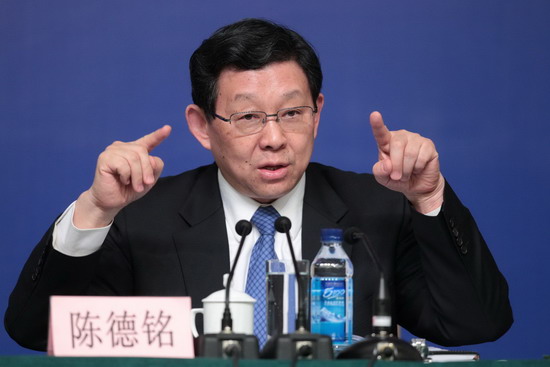 China's Commerce Minister Chen Deming speaks at a news conference on the sidelines of the annual session of the National People's Congress, in Beijing on Monday March 7, 2011. [Photo/Xinhua] |
Targeted imports will rise while export growth set to slow down
BEIJING - The trade surplus will decrease further this year and may even go into deficit for a few months, Minister of Commerce Chen Deming said on Monday.
This will be due to increased imports of high-tech products, green technology, resource-related goods (such as iron ore) as well as simplified procedures and tariff cuts on certain items, he said.
|
||||


The surplus has been in decline in recent years. In 2010 it decreased by 6.4 percent, from a year earlier, to $183.1 billion. This followed a 34 percent fall to $196.1 billion in 2009, from a year earlier.
In January, the surplus dropped by 53.5 percent year-on-year to $6.46 billion.
"The surplus will further drop in 2011. While export growth will decelerate, import growth will accelerate," Chen said at a news conference on the sidelines of the annual session of the National People's Congress.
"The main target this year is to cut the trade surplus through stabilizing exports and expanding imports."
Import growth outmatched the increase in exports in recent months as global demand remained fragile and commodity prices surged.
In 2010, exports grew by 31.3 percent, compared with 38.7 percent for imports.
In January, exports rose 37.7 percent, compared with 51 percent growth for imports.
During the November meeting of G20 finance ministers and central bank chiefs in Seoul, the United States proposed a ratio of trade surplus or deficit to a nation's GDP be set at 4 percent, in a bid to solve global trade imbalances. But a number of countries rejected the proposal.
Last year, the surplus-deficit ratio of GDP in the current account was 3.2 percent for China, but "it's hard to say whether the figure will drop to below 3 percent or not, but it will definitely get smaller", Chen said.
Zhou Shijian, a senior trade expert, described China's commitment to boost imports to balance trade as "wise" as it reduces friction with other nations.
The US has asked China to appreciate its currency to reduce the trade deficit, but Chen reiterated that reform of the exchange rate will be "gradual" and "controllable", and it's unreasonable to accuse China of keeping the yuan undervalued, he said.
According to some foreign media reports, the Ministry of Commerce is considering a tariff reduction on high-tech products and resource-related goods and is seeking opinions from other ministries.
"Simpler import-related procedures are a priority, and we are also considering reducing import tariffs on some goods," Chen confirmed.
Jia Kang, head of the institute of fiscal science, a think tank affiliated to the Ministry of Finance, said "we should firstly consider resource-related and high-tech goods when it comes to import tariff reduction. Relevant policies will probably come out soon. But it's not time to consider luxury and high-end goods."
Chen said at the news conference that China will "probably allow some of the made-in-China luxury goods to be directly sold in China", which is currently prohibited.
In three years, China will exempt import tariffs on more than 95 percent of categories of goods from the least-developed nations, he said.
Chen also urged the developed nations, including the US and European Union countries, to loosen restrictions on high-tech exports to China.

