|
This little book is part of a bigger series that Zhang and her team painstakingly researched, edited and published.
It is an encyclopedic collection that covers every aspect of Hani culture and lifestyle, with particular emphasis on the macro and micro ecosystems that make the region so unique.
As Zhang showed us around her beloved rice terraces, she recites a Hani song as she climbs with us:
"While all the stars are partying in the sky,
The palm trees are dancing happily on the earth."
 |
|
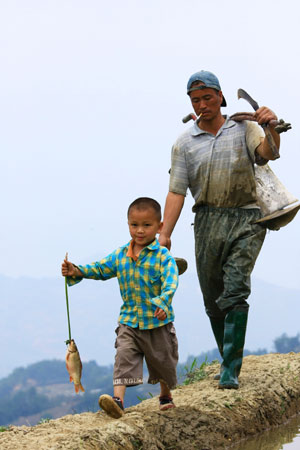
Father and son return from the paddy fields, with a fish for the dinner table. [Photos by Li Jincan / for China Daily] |
It is a well-preserved, sustainable eco-agricultural system and a unique agro-ecological cultural phenomenon borne out of the ancient wisdom of the Hani - a carefully choreographed harmony between man and nature.
In yet another song of the four seasons, the Hani are reminded, "the wisdom of past sages is like oil squeezed out of rock, and it is the life blood of our people."
There is a lot to be proud of. The forested hilltops, the village hamlets with their mushroom thatched roofs, the terraced rice fields, the little reservoirs and wetland patches, the underground water and the water network above ground - these are the visible aspects.
The intangible part of the heritage include the rich ethnic diversity of the Hani and Yi people, their oral history carefully preserved in songs and stories, the folk rituals and customs and most of all, a sustainable lifestyle that flows along with the natural energies of nature.
It is a combination of nature blessing the land, and the people appreciating and protecting these benevolent gifts.
That is the reason why the terraces have consistently good harvests, independent of the whims of drought or flood.
In this seemingly paradise-like existence, seeds of discontent have been sowed by the challenges of encroaching urbanization.
As we wandered among the rice terraces, some patches of fields were lying fallow, the surface cracked with neglect. It is not that these particular segments are any less fertile, it is because there is no one to tend them.
The families they belong to cannot afford to employ farm workers, and the young are away in the big cities.
Those left behind, the elderly, no longer have the strength to work their paddy fields.
Part of the problem, like many similar lowland agricultural enclaves, is the poor prices the grains command in the open market.
While the micro-ecology of the rice terraces can comfortably feed a family, there is little or no money for other modern day necessities like the electricity bill, televisions, computers, the post-'80 and post-'90 must-have gadgets of smartphones and tablets.
The rice varieties planted here are heirloom species, and do not yield the huge harvests of cross-bred rice plants.
Another reason cross-bred rice does not do well here is the need for pesticides and chemical fertilizers, which the Hani wisely resist.
Their terraces are fertilized by organic waste of buffalo, pigs, chicken and ducks, as well as green compost from fallen leaves and rotting weeds.
Their plants are kept pest-free by foraging chickens and ducks.
They are also fiercely protective of the red rice varieties grown here and would eat nothing else.
The red rice is descended from wild species cultivated for more than a thousand years since the first Hani settlers came to the Honghe region.
By now, it has evolved to include more than 20 sub-species including white, red, purple, glutinous and non-glutinous varieties.
To keep the gene pool healthy and disease-resistant, the Hani regularly exchange seed rice with neighbors from another village or another side of the mountain.
|
 |
|
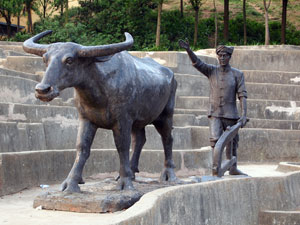
In the public square of Yuanyang Old Town, a set of bronzes commemorate the farmer and his water buffalo. |
Right now, the whole question of conservation hangs on the balance.
Living standards are comparatively low, and fall way below the national average.
To catch up, the Hani must push their products beyond their homes. They also need to welcome more visitors with spending power.
Tourism is a double-edged sword that must cleave a balanced path between profit and preservation.
While it can and should be encouraged, too many feet trampling about the rice terraces may also destroy what the visitors came to see. It has to be wisely managed.
And most of all, it is the Hani people and their way of life that must enjoy the benefits of tourism. Not the profiteers nor opportunists, whether they be private or corporate entities.
At the Honghe Hani Rice Terraces, that old adage about taking away only memories, and leaving footprints is not just a simple saying. It must be the rule of the game. Oh, and we must not forget the photographs.
|
 |
Contact the writers at paulined@chinadaily.com.cn and
canglide@chinadaily.com.cn. Li Yingqing contributed to the story


Copyright 1995 - . All rights reserved. The content (including but not limited to text, photo, multimedia information, etc) published in this site belongs to China Daily Information Co (CDIC). Without written authorization from CDIC, such content shall not be republished or used in any form. Note: Browsers with 1024*768 or higher resolution are suggested for this site.
License for publishing multimedia online 0108263 Registration Number: 130349