PARIS - In the past 20 years, the world has made progress in economic development, social cohesion and environmental protection in a bid to achieve sustainable development, during which education has played as one of the strongest pillars, UNESCO chief Irina Bokova told Xinhua.
The UNESCO are set to join world leaders and civil societies at the United Nations Conference on Sustainable Development (Rio+20) next week in Brazil to take stock of sustainable development progress and plan for future steps forward, Bokova said.
Education, key to sustainable development?
Before attending the Rio+20, a follow-up to the 1992 Earth Summit, the UNESCO director-general reviewed the commitments that the UNESCO has made in an effort to promote the development in the area of education, science and technology and culture, three keynotes related to the core of the Rio+20's sustainable development summit.
She said some 20 years ago, education was not considered to be important or relevant for sustainable development.
"We still know that the Second Millennium Development Goal, Education For All, is an issue or problem for many countries, although a lot of progress has been made. We think that having 67 million illiterate children in the world, not going to school, is a major problem and having 800 million illiterates is a threat to sustainable development and to stability in this world," she said.
Nowadays education has been firmly anchored into the development agenda as it is seen as one of the best of ways to "reach economic competitiveness, social cohesion and mobility in society, including also environmental protection," Bokova said.
"We have been strongly promoting education. It is our main priority in our agenda," she told Xinhua in the recent interview at her office in the Paris-based headquarters.
Science and technology also play a key role in the transition to sustainable development, a green economy and poverty eradication.
"We work with the (UN) Secretary-General to implement an important decision of the sustainability panel, to see how we make the better interface between science and policy," Bokova said, adding that the UN is set to launch a new major initiative in science, sustainable development and policy.
The UN official also underlined the importance and the need for technology transfer, citing the issues of environmental protection that should not be "looked as impeding on development."
Meanwhile, culture is pivotal in all policy decisions as well "because culture matters for development," contributes to economic growth and social cohesion and "after all, culture makes us human. And we think that it is important to have this side of sustainable development as well," according to the UNESCO director-general.
Bokova highly commended a slate of important strategies that have been made after the United Nations has adopted the Millennium Development Goals (MDG) in the area of education, environmental protection and poverty reduction.
"In 1992, 46 percent of the world population was living under the poverty line, was very poor. Nowadays it is about 26-27 percent which is a big progress," she said.
For the upcoming Rio+20, the UNESCO chief said she expected strong political commitment by world leaders and hoped that governments could agree on certain important benchmarks. "But the overall message is that the door is open and we have to continue working."
Immense progress witnessed in China?
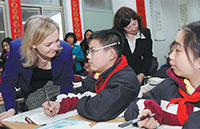
Bokova told Xinhua she was in Shanghai in May for a UNESCO conference on Transforming Technical and Vocational Education and Training (TVET) program co-organized with the Education Ministry of China, noting that the country has made tremendous progress in educational domain.
"China has drastically reduced illiteracy" and "dramatically improving the quality of its universities," she commended.
"Of course, given the dimension of the country, we know that there are still around 50 million illiterate people. But China has been making huge progress and is also sharing its experience now with other countries. China has adopted the plan 2010-2020 for improving the quality of the education system...," the UN official said.
She looked to expand the cooperation further to other areas, such as natural science, engineering and sustainable development with more Chinese universities.
Bokova said the Chinese government's effort for sustainable development was significant.
"We have lots of experience in different parts of the world of changing curricula and teacher training and introducing this notion of sustainable development in the school system. And I am sure that the Chinese Minister of Education and the government are taking very seriously this important challenge," the UNESCO director-general said.


Copyright 1995 - . All rights reserved. The content (including but not limited to text, photo, multimedia information, etc) published in this site belongs to China Daily Information Co (CDIC). Without written authorization from CDIC, such content shall not be republished or used in any form. Note: Browsers with 1024*768 or higher resolution are suggested for this site.
License for publishing multimedia online 0108263 Registration Number: 130349