
 Comments()
  Print
Print  Mail
Mail  Large Medium Small
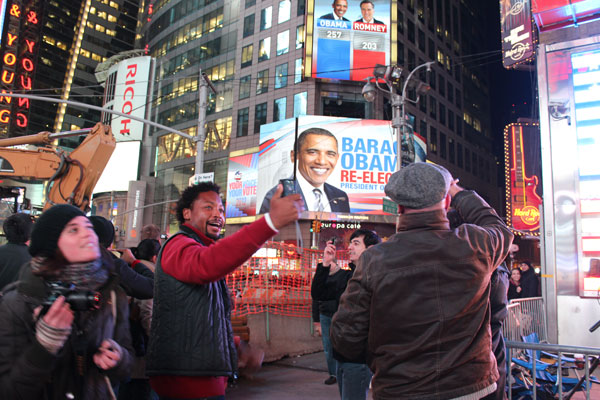 Obama supporters are celebrating cheerfully in Times Square, New York as Barack Obama has been re-elected. Yu Wei / China Daily |
The culmination of the US presidential race on Tuesday would also seem to end the slew of anti-China remarks from both major-party candidates, but experts say the outcome won't alter the nature of US-Chinese relations.
By turns, the newly re-elected Barack Obama and Republican hopeful Mitt Romney raised the specter of China as a threat to US economic prosperity but also as a potential partner - provided the Asian nation hews to Washington's version of fair trade.
In televised debates and campaign commercials, and at rallies for supporters, a litany of complaints against Beijing was unfurled - currency valuation, job outsourcing, the bilateral trade imbalance. Critics of such "China-bashing", including senior figures in each candidate's party, said the campaign would have done well to focus on domestic solutions to these problems rather than China's supposed role in creating them.
In the second Obama term, which begins in January, trade disputes with China that erupted this year or earlier will mean continued friction between the world's two biggest economic powers.
Unlike Romney, the Democratic president didn't promise to brand China a "currency manipulator" come January, but a series of decisions by Obama seemed to provide a glimpse into the near-term future of US-Chinese economic ties.
Chen Zhiwu, a Yale University finance professor who is an expert on China's economy, said he expects more bilateral economic disagreements and further signs of protectionism by the United States under Obama.
"More restrictions are likely, especially during his second term," Chen said. "He will have to pay back those voters in Ohio, Wisconsin and, of course, Michigan."
He was referring to manufacturing-reliant states in which Obama had campaigned heavily but where voters have long felt stung by the outsourcing of jobs to low-cost labor markets including China.
In September, while campaigning in Ohio, a state where one in eight jobs is tied to the American auto industry, the president announced his administration's trade complaint against Chinese automakers and auto-parts suppliers with the World Trade Organization. It was a move seen by many as an attempt to win "swing" state voters in the election.
As Obama stressed in his final debate with Romney, his administration has brought more cases against China to the WTO than George W Bush did during his two presidential terms.
That record was also cited by US Ambassador to China Gary Locke at a recent town hall discussion in Beijing. "We are constantly pressing China to do even more," Locke said.
This year alone, the Obama administration has imposed tariffs of as much as 250 percent on imports of Chinese solar-energy panels. Industry players in both countries have warned that the tariffs - meant to punish China for State subsidies of its solar industry - would be mutually damaging. A final determination on whether to implement the tariffs is expected sometime this month.
A study by the Coalition for Affordable Solar Energy, a group of US solar firms, found that a 100 percent or 50 percent tariff on imported Chinese panels would lead to the loss of about 50,000 or 43,000 American jobs, respectively, over the next three years.
Ann Lee, an economics professor at New York University and author of What the US Can Learn from China, said the Obama tariffs are in stark contrast to Romney's rhetoric.
"In fact, Obama's stance against China is so hawkish that it makes former president George W Bush look soft in comparison, she said.
Obama is likely to try to mend the US-China relationship and "initiate greater diplomacy over a range of issues to find common ground", Lee expects. Romney, she said would probably have done "the opposite, given the strong interest groups in Washington that want to label China an enemy".
The US economy has rebounded - slowly - from the subprime-mortgage crisis and resulting financial tumult Obama inherited in 2009. While his policies, some a continuation of Bush's, helped avert catastrophes in the banking and automotive industries, Obama is also blamed for an unemployment rate that has hovered around 8 percent, spending that helped push the government's debt to $16 trillion and a health care overhaul that Republicans claim is too costly.
At least 37 US states are home to some form of Chinese investment, supporting about 30,000 jobs in sectors including auto parts, information technology and services, according to consulting firm Rhodium Group.
The upside of this economic activity was offset by the candidates' campaign talk of China as an economic threat.
Obama in September blocked Ralls Corp, which is owned by executives of China's Sany Heavy Industry Co, from buying four wind farms near a US navy test site in Oregon, citing national-security concerns. It was the first time in more than two decades that a US president barred a foreign investment.
In October, the House of Representatives Intelligence Committee capped a yearlong investigation with a report accusing Chinese telecommunications providers Huawei Technologies Co and ZTE Corp of allegedly unfair and illicit practices. The report warned US companies and the federal government that the two Chinese suppliers threaten national security and shouldn't be trusted as business partners.
Jon Taylor, a professor of political science at the University of St Thomas in Houston, said that a continuation of China-bashing would be "good politics, bad economics".
"It is counterproductive for bilateral relations that are far more extensive than just economic issues," he said. "Blaming China for jobs lost during a recession may be popular with the average American voter, but the worst thing that could happen to the American economy is if China's economy were to falter."
Zhu Zhiqun, a professor of political science at Bucknell University in Pennsylvania and author of US-China Relations in the 21st Century: Power Transition and Peace, said Obama's victory means there will be no change in White House policy toward China and Asia.
"Democrats tend to have a fuller agenda and often have conditions attached to commercial relations," Zhu said. "They are more likely to emphasize universal values such as democracy and human rights in the relationship."
Contact the writer at yuweizhang@chinadailyusa.com

 Modeling contest part of China-US exchange
 Specially fertilized tea
 Simulator to support A320neo commissioned
 China's cultural sector sees steady growth in 2011
 Travel chaos after snowstorm hits NE China
 Inflation expected to rebound in November
 Grain output grows for 9th consecutive year
 White House-like buildings in E China city
Copyright 1995 - 2010 . All rights reserved. The content (including but not limited to text, photo, multimedia information, etc) published in this site belongs to China Daily Information Co (CDIC). Without written authorization from CDIC, such content shall not be republished or used in any form. Note: Browsers with 1024*768 or higher resolution are suggested for this site.
License for publishing multimedia online 0108263 Registration Number: 20100000002731