Standing on a ramshackle wooden platform about 3 meters above the ground, farmer Huang Demin edged forward, forcing one pig after another to "dive" into the river below.
Most do not like the experience, he concedes, yet he believes it boosts the animals' appetite, so they grow faster.
 |
|
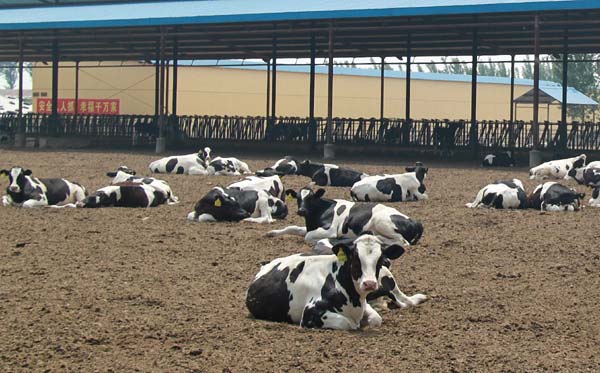
A dairy farm at the Beijing Sanyuan Luhe Dairy Cattle Center provides cows with sufficient space and a comfortable resting area. [Photo provided to China Daily]? |
Images of Huang's making his livestock airborne in Central China's Hunan province were widely circulated on the Web this week, prompting equal measures of curiosity and criticism.
"What this farmer is doing is against the pigs' nature," said Gu Xianhong, professor at the Institute of Animal Sciences under the Chinese Academy of Agricultural Sciences. Making the pigs dive, he said, "merely makes the animals anxious and therefore violates their welfare".
To the relief of animal-rights campaigners, authorities aim to curb such activities.
The General Principles of Animal Welfare Assessment, noncompulsory guidelines largely targeted at the treatment of livestock, are expected to come into effect this year.
 |
|
Farmer Huang Demin forces his pigs to dive into a river below to "boost the animals' appetite" at Guanshan village in Hunan province on Nov 11. [Photo/China Daily]? |
In 2010, legal experts drafted a version on China's Animal Welfare Law that is intended to criminalize maltreatment of animals and fine those who eat dogs. However, it was substantially watered down after public objection.
"One reason was the lack of sufficient scientific evidence and a guiding principle to assess what animal welfare is," said Jia Zili, secretary-general of Chinese Veterinary Medical Association's Animal Health Service and Welfare Branch.
"That's what we are doing now (with the general principles) — telling the public what animal welfare is and how it should be assessed."
According to experts who took part in writing the forthcoming regulation, the reasons behind wanting to protect animal welfare are both commercial and ethical.
Whatever the motivation, for Min Chengjun, manager of fresh produce for Yurun Group, a pork company in Jiangsu province, quality is a driving force to changing attitudes.
"Take, for example, preventing disease," he said. "Improving animals' living conditions and putting them in a hygienic environment prevents diseases and therefore boosts profitability.
"Also, when animals are under great stress, it results in lower-quality meat," he said.
Min added that sufficient research shows that when pigs are upset, their meat becomes pale, soft and exudative; or dark, firm and dry, affecting its price.
"It's simple: Consumers want to buy meat from healthy pigs," Min said.
Maintaining trust
Farmers have been keeping livestock for human consumption for thousands of years, and experts agree that the vast majority of farmers already understand that their fate is inextricably linked to the well-being and quality of their animals.
Yet, as the country has continued on a path of rapid urbanization, the gap between farmers and consumers has widened, causing distrust, according to Qiao Lu, director of the Beijing Sanyuan Luhe Dairy Cattle Center.
"Consumers know less and less about the way farm animals are treated," he said. "For us, the adoption of standards that meet animal welfare requirements is necessary to maintain confidence in livestock products."
Qiao said his company, one of China's largest dairies, began to adopt animal welfare policy 12 years ago and saw its annual milk yield rise from 6 to 7 metric tons to about 11 tons.
Pressure from fulfilling international obligations and combating "green" trade barriers also provided motivation for the new guidelines, according to Jia Zili at the animal health service and welfare branch.
Jia said the regulation is framed under the basics of the Terrestrial Animal Health Code, issued by World Organization for Animal Health, of which China is a member state.
With more than 661.7 million pigs slaughtered each year, China is the world's largest pork producer, accounting for almost half of total global output. Exports, however, account for only 6.57 million tons, less than 1 percent, according to the 2011 annual report on China's pig industry, released by the National Swine Industry Technology Center, co-founded by the Ministry of Agriculture and the Ministry of Finance.
The story is similar in the beef and chicken industries.
"Part of the reason for the low level of exports is the lack of animal welfare and sanitary standards (in China), so export to major markets such as the European Union is impossible," Jia said. "Writing animal welfare into Chinese legislation would certainly have an impact in the international market where increasing demand animal welfare products sets a green trade barrier."
Qu Bin, quality director for Husi Food, which has been the sole supplier for McDonald's in China for more than two decades, said: "Animal welfare is a brand in the international market.
"Doing business with other countries, we have to play by their rules," Qu said. "With the regulation, we hope more Chinese companies will follow quality practices, providing us more choices in upstream companies."



Copyright 1995 - . All rights reserved. The content (including but not limited to text, photo, multimedia information, etc) published in this site belongs to China Daily Information Co (CDIC). Without written authorization from CDIC, such content shall not be republished or used in any form. Note: Browsers with 1024*768 or higher resolution are suggested for this site.
License for publishing multimedia online 0108263 Registration Number: 130349