History's darkest days inspire an unusual theme park in Shanxi
War. What is it good for? Well, tourism, according to a county famous for its revolutionary past.
A theme park based around the War of Resistance against Japanese Aggression in North China's Shanxi province has so far proved a big hit with fans of "red" tourism.
 |
|
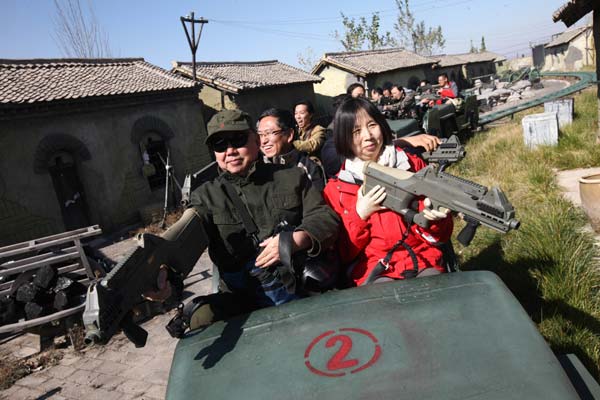
Tourists experience simulated warfare at the Eighth Route Army Culture Park in Wuxiang county, Shanxi province, in October. [Photo by Xu Chongde / for China Daily] |
For just 90 yuan ($15), visitors can don the uniform of China's legendary Eighth Route Army for mock battles with Japanese, as well as enjoy a live-action recreation of a famous victory.
"The counterstrike-style feature is one of the most popular features," said Shi Yongbing, spokesman for the Wuxiang county government, which runs the park.
Visitors can experience 10 guerrilla methods applied by the Eighth Route Army - the larger of the Communist Party of China's two forces during the War of Resistance against Japanese Aggression - in a realistic setting created by professional performers with high-tech sound and lighting effects.
"Wuxiang is not a traditional tourism county," Shi said. "However, in tourism development we need to fully take advantage of its position as the former headquarters of the Eighth Route Army and tap its potential as a 'red tourism' site."
Red tourism, a combination of patriotic education and recreation, has boomed in recent years, thanks largely to government support.
No holiday for some
Not everyone is in support of such attractions, though, and some people have accused the park of being offensive to other nations, particularly Japan.
In the guerrilla experience, for example, visitors use fake weapons to shoot pictures of Japanese soldiers, which critics say is distasteful.
"Now the war is over, I don't see why former enemies should bear grudges or harbor bitter resentment against each other," said student Wang Yueyue at Peking University. "Why dig up the past if you can move on?"
Shi disagreed with the criticism, and said: "The theme park is meant to re-create history so the present generation doesn't forget. There is no political factor.
"Everything we re-create happened, we're not making anything up," he added.
However, Zhang Hui, a professor of tourism at Beijing Jiaotong University, said he feels that attractions catering to the 'red' market sometimes tend to veer toward the vulgar.
"For historic monuments and sites, tourism development should be solemn and serious, it should not try to please the public with claptrap," he said. "It's not respectful for history nor for the soldiers."
The fact an increasing number of Chinese tourists are visiting former revolutionary bases and landmarks is a good thing, he said, explaining that they are of great educational significance and greatly promote socioeconomic development in areas that are typically rural and poorer than other parts of the country.
However, Zhang said too much "amusement" may diminish the significance in the eyes of the next generation.
"It's necessary that historic sites respect the history that occurred on the land before and pass it on in a solemn way," he added.
Benefits to locals
Wuxiang received more than 2.1 million visitors between January to October, a year-on-year increase of 44 percent, generating an income of more than 1.6 billion yuan, according to government records.
"The theme park has created more than 300 employment opportunities in 10 months, and some 200 households have turned their homes into rural guesthouses, providing food and accommodation," Shi said. "It has also created jobs for residents in nine nearby villages."
He said Taihang Mountain, a musical extravaganza that re-creates a historic air strike by the Japanese army and includes some folk performers, has provided extra income for about 600 farmers.
Ren Chengtang, who lives nearby, said he had earned 40,000 yuan by playing a shepherd and providing his own sheep for the show over the summer. The show is closed in winter and will re-open in the spring.
"Each actor is paid 30 yuan per performance, along with a 5 yuan transport allowance," Shi said. "A subsidy of 90 yuan also goes to the owner of the 40 sheep that appear in the show."
The county has just started to promote red tourism, which is still in a period of development, he said. However, there are plans to build a cultural industry and promote the culture and history of the Eighth Route Army.
"Although the province has always relied heavily on coal, it's tapping into other potential areas to develop its economy and will look for multiple sources of revenue in the future," Shi added.
Sun Ruisheng in Taiyuan contributed to this story.
zhengxin@chinadaily.com.cn



Copyright 1995 - . All rights reserved. The content (including but not limited to text, photo, multimedia information, etc) published in this site belongs to China Daily Information Co (CDIC). Without written authorization from CDIC, such content shall not be republished or used in any form. Note: Browsers with 1024*768 or higher resolution are suggested for this site.
License for publishing multimedia online 0108263 Registration Number: 130349