

 Comments
  Print
Print  Mail
Mail  Large Medium Small
YINCHUAN - China will continue to provide financial and technological support for Chinese companies that wish to build infrastructure in Arab states, as well as improve its domestic investment environment for Arabian enterprises, according to a top Chinese official.
Top political advisor Jia Qinglin told officials and entrepreneurs attending the second China-Arab States Economic and Trade Forum in Yinchuan, the capital of northwest China's Ningxia Hui autonomous region, on Wednesday that China and Arab states should further boost economic cooperation in the fields of trade, investment, energy and infrastructure.
"China is willing to work with Arab states to cement mutual political trust and deepen exchanges in order to achieve mutual benefit and create a 'win-win' situation," said Jia, who chairs the National Committee of the Chinese People's Political Consultative Conference (CPPCC).
He said China will continue to encourage its enterprises to invest in the manufacturing and agricultural sectors of Arab states.
In the meantime, China will further improve its investment environment in order to court Arab enterprises that wish to set up operations in China, Jia said at a conference following the forum's opening ceremony.
Booming Economic exchanges
By the end of 2010, China's accumulated investment in Arab states exceeded $15 billion, while Arab enterprises' investment in China totaled 2.6 billion dollars, making it one of the fastest growing investment markets for China, Jia said at the conference.
Trade between China and Arab states has also experienced fast growth over the past few years, and the League of Arab States has become China's seventh largest trading partner, Jia said.
Trade volume between China and the Arab League members totaled 145.4 billion dollars in 2010, up 34 percent year-on-year, according to statistics from the Ministry of Commerce.
The full-year trade volume is expected to reach 200 billion dollars through booming cooperation in the petroleum and engineering sectors, said Pei Changhong, an economist from the Chinese Academy of Social Sciences (CASS).
Jia urged both Chinese and Arab enterprises to further expand the trade scale and deepen cooperation in traditional petroleum exploitation and trade as well as new energy development.
Additionally, China and Arab states need to further strengthen cooperation in infrastructure construction and tap the potential of new areas like logistics, finance, tourism and cultural innovation in order to diversify exchanges between the two sides, Jia said.
The five-day forum will focus on economic and trade cooperation in agriculture, science and technology, energy, finance, tourism and the publishing sector.
Forum as platform
Ningxia is China's sole autonomous region for the Hui ethnic people, who are largely descended from foreign Muslims. The Hui people were forced to move or voluntarily migrated into China during the early years of the 13th century, when Mongolian troops were conducting expeditions.
Ningxia served as a "melting pot" of Chinese and Arabian culture in ancient times, functioning as a bridge for trade and cultural exchanges?between China and Arabian nations, Jia said.
"The region should now play a more important role in boosting economic and trade cooperation between both sides," Jia said.
The Sino-Arab forum, first held in 2010 to facilitate and boost economic and trade between China and Arab states, has attracted crowds of entrepreneurs from both regions to seek business opportunities.
A trade fair in which vendors displayed halal food, Muslim commodities and energy and chemical engineering products is being held alongside the forum in Ningxia, which is home to about 10 percent of China's 20 million Muslims.
More than 7,000 delegates, including 1,200 from 76 countries and regions, are attending this year's forum and trade fair, according to the event's organizing committee.
"I hope I can make more friends and find some business opportunities at this forum," Saudi Arabian businessman Ahmed Saleh said at the exhibition center.
Saleh established a company in the city of Yiwu in east China's Zhejiang Province that offers services for Chinese and Saudi Arabian trade companies. He said his company has witnessed rapid trade growth between China and Saudi Arabia over the years.
With trade booming between China and Arab states, more Arabians are coming to China to learn Chinese.
Egyptian Mohamed Abuelmgd is one of these students. A post-graduate majoring in Chinese language at Zhejiang Normal University, the business-savvy Abuelmgd also owns a trade company in Yiwu.
"I hope to find some business opportunities here in Ningxia. I also want to learn more about this region, as there are a lot of Muslims here," Abuelmgd, who has got a Chinese name Da Cheng, told reporters in fluent Chinese.
He said many of his classmates in Egypt are learning Chinese, hoping to become interpreters or come to China to set up their own businesses.
"The China-Arab forum holds great significance for strengthening economic ties and cultural exchanges between Ningxia, as well as neighboring Gansu province and the Xinjiang Uygur autonomous region, and Arab countries," Pei with the CASS said.
On Monday, the Yinchuan city government started construction on the Ningxia International Conference Center, which will serve as a permanent public venue for the top-level Sino-Arab forum.

 Continuous rainfalls affect millions of people across China
 First heat wave hits Shanghai
 Heartwarming stories during China's floods
 Torrential rains wreak havoc across China
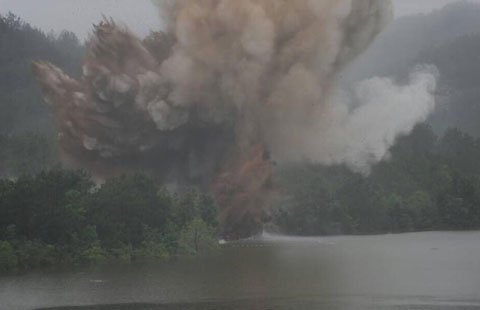 Dam's floodway blasted to discharge water in Hubei province
 In pics: Installation process of world's largest telescope
 How much spice can you take?
 Yangtze River reaches flood stage for first time this year
Continuous rainfalls affect millions of people across China
Yangtze River reaches flood stage for first time this year
Continuous rainfalls affect millions of people across China
 Liujiang River in south China sees 2nd flood peak this year
 Chinese herbalists offer free US treatment
 Eid al-Fitr celebrated worldwide
 Chinese basketball legend Wang Zhizhi bids farewell
 Serena batters Pavlyuchenkova to join Venus in semis

Copyright 1995 - . All rights reserved. The content (including but not limited to text, photo, multimedia information, etc) published in this site belongs to China Daily Information Co (CDIC). Without written authorization from CDIC, such content shall not be republished or used in any form. Note: Browsers with 1024*768 or higher resolution are suggested for this site.
License for publishing multimedia online 0108263 Registration Number: 20100000002731