Comments
  Print
Print  Mail
Mail  Large Medium Small
Study shows excessive infrastructure investment negatively impacts economy
Whether China's largely State-driven infrastructure construction is excessive is always a topic subjected to vehement debate at home and abroad. A recent study offered a new clue to the answer.
The study, commissioned by the Shanghai-based SIFL Institute and led by two researchers with the Antai College of Economics and Management of Shanghai Jiao Tong University, touched upon the issue by comparing China's infrastructure investment with its private productive capital.
 |
|
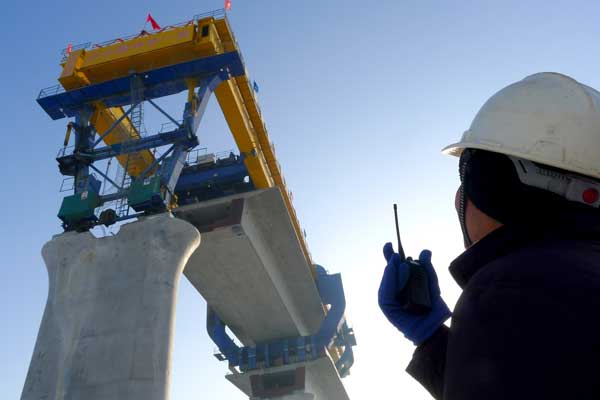
According to experts, it is reasonable for China to adopt an "infrastructure going ahead" strategy in its go-west campaign. The problem, however, is the breakneck infrastructure investment pace has not been followed with industrial investment growth, primarily led by the private sector.[Cai Zengle / for china daily] |
The study is built upon an assumption that there is an optimal allocation between the infrastructure investment and private productive capital. Any deviation from the balance leads to efficiency losses, thereby resulting in losses in GDP.
Huang Shaoqing and Shi Hao analyzed China's investment data during 1985 and 2011. In their calculation, infrastructure includes electricity, gas, water, transportation, warehousing and postal, water conservancy, environment and public utilities and information transmission. The remainder is counted as private productive capital.
The study found the largest loss occurred in 1997, when infrastructure investment was severely inadequate, causing losses amounting to 2.58 percent of GDP that year. This means that factor input could have generated more GDP if infrastructure and private productive capital went hand-in-hand.
Since 1998, the government has ramped up infrastructure investment by issuing bonds. The loss because of insufficient infrastructure investment has been gradually alleviated. In 2003, the cost was reduced to 0.64 percent of GDP that year.
The trend, however, has reversed since 2003. From 2003 to 2008, costs resulting from excess infrastructure investment in economically underdeveloped regions and insufficient investment in most developed coastal economies kept rising, reaching 1.31 percent of GDP in 2008.
At the end of 2008, China decided to roll out a large-scale stimulus package to avert the contagion effect of the global financial crisis. In the following two years, much of the credit spree flooded the infrastructure sector.
In other words, the infrastructure spending spree happened at a time when infrastructure in most regions was already over-built. Hence, the ratio of GDP losses has steadily risen from 2008's 1.31 percent all the way up to 2011's 1.85 percent — 872.4 billion yuan ($135.3 billion).
A more accurate scenario of the losses is seen in the regional breakdown. The study showed though infrastructure investment is generally appropriate, in some eastern regions even slightly insufficient, investment in western regions was generally excessive compared with private capital.
For example, Beijing and Fujian province's ratio of GDP losses in 2011 are among the lowest, showing they have a relatively good balance between infrastructure and private productive capital. Jiangsu's infrastructure investment is inadequate, causing losses of about 4 percent of its GDP in 2011. Central Henan province's infrastructure investment is also inadequate, causing a 3.42 percent toll on its GDP. Zhejiang province's infrastructure investment is slightly inadequate, with a 0.25 percent toll on GDP.
However, in the vast central and western regions, excessive infrastructure investment is a common scene. Excess is particularly severe in Yunnan, Guizhou and Qinghai provinces. The Inner Mongolia autonomous region, the Guangxi Zhuang autonomous region and Gansu province have long seen excessive infrastructure investment, but the loss narrowed in 2011.
"Infrastructure investment creates both demand and supply in economics. But the problem is, in most hinterland regions, its function is overwhelmingly regarded by local officials as creating short-term ‘demand'," said Huang.
The expense of this shortsightedness is that the massive infrastructure investment's role in improving the long-term supply ability is ignored.
"Local officials simply assume that government's input in infrastructure would spur the private sector's investment, thereby generating fiscal revenue for local governments to recover their costs," said Huang. "But that linear development is not necessarily going to happen."
According to Huang, it is reasonable for China to adopt an "infrastructure going ahead" strategy in its go-west campaign. The problem, however, is the breakneck infrastructure investment pace has not been followed with industrial investment growth, primarily led by the private sector.
"Western regions have been desperate to scale up infrastructure investment, but improvement in infrastructure is not accompanied with improvement in governance and investor environment. This has made them less attractive to private investors and failed to generate revenue from their infrastructure investment," Huang said.
If the government's input failed to attract follow-up private productive capital, it risked accumulating "white elephants" and lead to debt crisis. Huang's study found that although in most provinces governments could repay their debts with additional revenue from additional industrial capacity in the next 30 years, five regions might fail to repay their debt by 2039. They include Qinghai, Xinjiang, Yunnan, Guizhou and Inner Mongolia.

 Chinese premier eyes closer ties with ASEAN
 Orphans in C China experience family life
 Students face new term and military training
 Giant rubber duck set to float in Beijing
 Sculptures pay tribute to war heroes
 Helicopter expo to open in Tianjin
 Pollution kills fish in C China river
 Quirky street sweeper turns out to be nuisance

Copyright 1995 - . All rights reserved. The content (including but not limited to text, photo, multimedia information, etc) published in this site belongs to China Daily Information Co (CDIC). Without written authorization from CDIC, such content shall not be republished or used in any form. Note: Browsers with 1024*768 or higher resolution are suggested for this site.
License for publishing multimedia online 0108263 Registration Number: 20100000002731