

 Comments
  Print
Print  Mail
Mail  Large Medium Small
WASHINGTON - China on Tuesday warned Japan against leading the Asia-Pacific down the path to confrontation, which would greatly damage all countries in the region.
Cui Tiankai, China's ambassador to the United States, made the remarks in response to a question after speaking on China's foreign policy and current China-US relations at the Paul H. Nitze School of Advanced International Studies at Johns Hopkins University in Washington.
Cui expressed concern about an agreement reached last week at the "2+2" Japanese and US foreign and defense ministers meeting in Tokyo on expanding further military cooperation, including a plan to revise the bilateral security treaty by the end of next year.
This was regarded as another attempt by Japan to bolster its military might in order to press its illegal claims over the disputed Diaoyu Islands in the East China Sea, which was historically part of China's territory, he said.
Cui said some of China's territorial disputes with neighbors, including Japan, were left over from history and should be worked out through bilateral negotiations and dialogues.
"If the condition is not ready yet, we have the patience to wait. We're not in a hurry to resolve all the disputes overnight," he said, but he cautioned China had to respond if there were provocations.
The Chinese envoy said there were two basic views for the future of the Asia-Pacific: one was that the region was the economically most promising in the world and hoped to turn it into a huge marketplace full of opportunities for every nation; the other regarded the region as full of conflicts and dangers, and tried to turn it into a battlefield.
"The two views will lead to different futures of the region," Cui said. "The first one is in the common interests of all peoples in the Asia-Pacific countries, including China, the United States and Japan, but the second one will cause great damage to the region."
"The leaders, politicians and scholars (in the region) especially have to be very careful about this, and make the right choice," Cui said.
Cui, who was China's ambassador to Japan from 2007-2010, stressed China stood for building "a stable and friendly relationship" with Japan, while expressing deep concerns about "some disturbing tendencies" in Japan's policies and its outlook on history.
"Some Japanese politicians believe that Japan lost World War II only due to the atomic bombs dropped by the United States. As a result, they think so long as they don't antagonize Americans, everything will be OK for them. They don't have to take care of the concerns of other countries," Cui said.
"I think this is very wrong and dangerous," he said. "Japan was defeated in World War II not by advanced weapons, but by the strong will and determination of peoples in Asia and the world as a whole."
It was in the interests of the United States and other countries in the Asia-Pacific to maintain the post-war order, the Chinese diplomat said, while urging Japanese politicians to "make the right choice."
In his speech, Cui said China's foreign policy was guided by two major principles of independence and peace, which derived from China's long history and traditional culture.
On the China-US relationship, the Chinese envoy said it was currently "in good shape" after four decades of joint efforts to promote its development. Chinese President Xi Jinping and his US counterpart Barack Obama had held two summits this year so far, and the two sides maintained close contacts through effective top-level communications and dialogue.
The two countries were currently working together to build a new model of major-country relationship based on mutual respect and win-win cooperation, which conformed with the new realities in the 21st century, the long-term interests of the two sides, and the expectations of the international community, Cui said.
On the issue of the Korean Peninsula, he said China's position was quite clear: it stood for denuclearization, for peace and stability, and for negotiations and dialogue to resolve the issue.
The six-party talks, which have been stalled since 2008, still offered the best feasible mechanism for negotiations among all relevant parties on the issue, he said.
"So I hope that the six-party talks can be resumed at an earlier date when the conditions are right. And the six countries can really move forward toward denuclearization and work out mechanisms, or arrangements, for the long-term stability in northeast Asia," Cui said.
 Rare look in Shaolin temple
 Henan chokes on lingering smog
 In photos: Typhoon Fitow aftermath
 Painting that grabs in E China
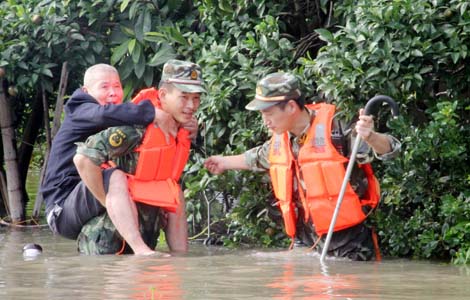 E China battles Typhoon Fitow
 Highfliers at Intl Aquatic-Speed Competition
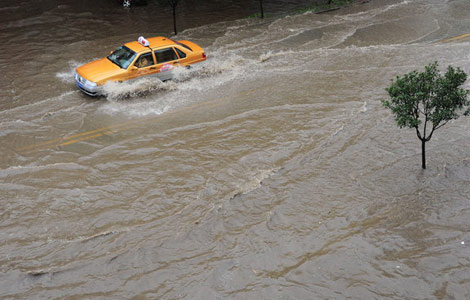 Typhoon Fitow affects 4.56 million people in E China
 Typhoon Fitow affects over 3m people in E China
Copyright 1995 - . All rights reserved. The content (including but not limited to text, photo, multimedia information, etc) published in this site belongs to China Daily Information Co (CDIC). Without written authorization from CDIC, such content shall not be republished or used in any form. Note: Browsers with 1024*768 or higher resolution are suggested for this site.
License for publishing multimedia online 0108263 Registration Number: 20100000002731