Xi pledges to boost ties with Indonesia
By Wu Jiao in Jakarta and Zhang Yunbi in Beijing ( China Daily )
Updated: 2013-10-03


Countries ink deals on fisheries, defense as well as aerospace
|
 |
|
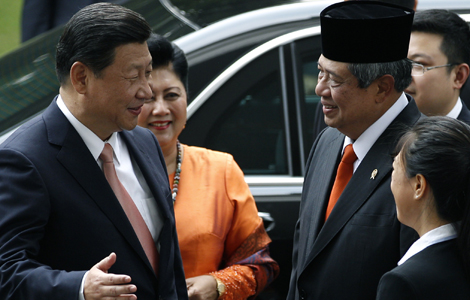
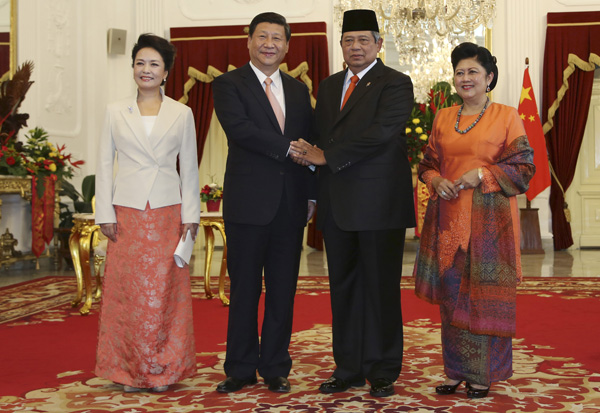
President Xi Jinping and his wife Peng Liyuan pose with Indonesian President Susilo Bambang Yudhoyono and his wife Ani before a meeting at the Merdeka Palace in Jakarta on Wednesday. Xi is making his first visit to Southeast Asia since taking office, arriving in Indonesia to boost ties and economic partnerships with the region's biggest country. Achmad Ibrahim / Associated Press |
President Xi Jinping pledged on Wednesday to set up an Asian investment bank to help facilitate regional connectivity as he visited the Southeast Asian region.
The bank will provide capital support to infrastructure construction in regional developing countries, including Association of Southeast Asian Nations countries, Xi said.
It is the first time that China has proposed such an Asian investment bank to aid regional connectivity.
The bank will collaborate with the existing multilateral development banks within or outside the region, complementing each other and ensuring the sustained stability of development of the Asian economy, Xi said.
"Boosting connectivity is now a necessary step for China and the Southeast Asian Nations to deepen their cooperation, and relevant projects are in desperate need of funding from such an investment bank," said Zhang Yunling, a senior research fellow of Asia-Pacific studies at the Chinese Academy of Social Sciences.
The meeting between Xi and his Indonesian counterpart Susilo Bambang Yudhoyono on Wednesday afternoon saw them ink a trade plan for the next five years and also agree to upgrade their bilateral cooperation to the level of a comprehensive strategic partnership.
"We have once again made history by agreeing to forge a comprehensive strategic partnership," Yudhoyono said after the presidential talks.
Currency swap deal
Among cooperation agreements inked on fisheries, aerospace and defense, the two countries also announced a 100 billion RMB-Rupiah currency ($16.3 billion) swap deal on Wednesday to fend off financial instability due to the fragility of developed economies.
The deal is a renewal of the one signed in 2009, and Xi said the two countries "are actively considering enlarging the scope of the deal".
The agreements demonstrate the "strong will and the urgent demand" from both sides to upgrade trade and investment ties, said Zhang.
"In the past, Chinese businesses focused more on trade and contracting services than investment in Indonesia. But now the investment part is being enlarged to make a stronger industry chain," Zhang said.
Indonesian ambassador Imron Cotan said prior to Xi's visit that the original swap arrangement, signed in 2009, was designed to stabilize the Indonesian economy amid the 2009 economic and financial crisis, sustaining two-way trade and investment.
"It successfully achieved its objective," he said, adding that "coupled with prudent fiscal and monetary policies taken by the Indonesian government as well as by high domestic consumption, the swap agreement managed to stir the Indonesian economy away from turbulence".
The two countries have also agreed to build a industrial park in Indonesia, but offered no details in the Wednesday news conference.
The park will help more Chinese firms invest in Indonesia, especially in the energy sector, as Indonesia recently introduced a ban on the export of raw mineral resources, said experts.
"The new industrial park will help employ more local workers and is greatly beneficial for both sides. Such investment takes better care of the interests of Indonesia and local people," said Zhang.
China-Indonesia trade has been growing rapidly in recent years, developing from $26.6 billion in 2009 to $66 billion by 2012, with China becoming Indonesia's second largest trade partner.
Bilateral trade in the first half of 2013 hit $33.84 billion, up 4.6 percent from the same period last year, according to the Chinese embassy in Indonesia.
However, bilateral trade only ranks fourth among trade between China and ASEAN countries.
Indonesia's strength is on the rise in the regional and international arenas, and the improvement of the China-Indonesia relationship is "tightly linked to the relationship between China and ASEAN", said Chen Shiqiu, former Chinese ambassador to Indonesia.
Ruan Zongze, vice-president of the China Institute of International Studies, said Indonesia is home to the headquarters of the 10-member ASEAN, and is widely known for its third largest population in Asia, which means "an enormous strategic significance" for China in the economic and political dimensions.
"Strengthening and upgrading the strategic partnership with such a regional power will further facilitate China's neighborly diplomacy and future policies toward the entire Southeast Asian region," Ruan said.
Xi Jinping will make a special address to the People's Representative Council of Indonesia on Thursday, the first such honor for a visiting Chinese politician. His speech will elaborate on China's vision to promote bilateral ties and China-ASEAN relations as well as China's peaceful development, vice-Foreign Minister Liu Zhenmin said on Sunday.
After Indonesia, Xi will visit Malaysia and attend the 21st leaders' meeting of the Asia-Pacific Economic Cooperation in Indonesia's Bali.
Indonesia key to upgrading China-ASEAN relations
Trip to improve 'connectivity' between nations
Visit will carry forward friendship
Strategic considerations important in mutual ties
Schedule

President Xi visits Indonesia, Malaysia, attend APEC summit
Oct 2 to 3: Pay State Visit to Indonesia
Oct 4 to 5: Pay State Visit to Malaysia
Oct 6 to 8: Attend the 21st economic leaders' meeting of APEC forum and meet with global leaders in Bali, Indonesia



Forum
China should increase investment in ASEAN
China should ratchet up cooperation with Association of Southeast Asian Nations countries to expand Beijing's regional influence while countering Washington's Asia-Pacific pivot strategy.
Territorial disputes remain an obstacle
To a lesser extent, relations may also be negatively affected by internal problems involving treatment of ethnic Chinese minorities.