Despite progress in improving attitudes toward the lesbian, gay, bisexual and transgender communities, intolerance is still an issue, said Xiao Tie, director of the Beijing LGBT center.
As an open bisexual, she said that like many others in the community she's under huge pressure from family and society, and the issue of sex remains largely "stigmatized."
|
 |
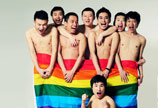
| Rainbow flag flies high in Shanghai |
|
 |
"China's first LGBT report issued recently by the United Nations Development Programme might be a high-profile positive start to help build a more tolerant and respectful living environment for the communities here," she said.
Discrimination against LGBT people is still rampant in China, where many hold negative attitudes toward diversity of orientation, particularly at schools and work places, the report said.
"The government should be more aware of the issue and help tackle the difficulties facing the group because of their non-mainstream gender identity and sexual orientation," said Liao Aiwan, UNDP's LGBT program officer in China.
Other countries in Asia like Thailand, Mongolia and Vietnam have already recognized the issue and made efforts, particularly at government level, to protect LGBT rights, she added.
The report is actually part of a UNDP project called the Being LGBT in Asia Initiative, which seeks to expand protection to LGBT individuals in eight Asian countries, including China.
Usually, the community accounts for at least 5 percent of the population. Some suggested the figure could be about 10 percent.
"LGBT people face violence and discrimination for no other reason than being who they are, and as always the UN is here to support building a world of equality and justice," said UN Secretary General Ban Ki-moon.
"China has made important progress in building a society where prosperity and dignity can be enjoyed by all," he added.
According to Liao, China's LGBT communities only became visible in the late 1990s, much later than counterparts in the West.
A more concerted movement was galvanized in response to the AIDS epidemic after 2000 along with an inflow of international funds combating HIV/AIDS, she said.
However, many still hide their status due to pressure from society and families, according to the report. Many are eventually forced into a heterosexual marriage.
In the public arena, LGBT content is still banned in movies, video games and TV productions, it said.
Compared with peers in the West, "family pressure is even greater for Chinese LGBT, particularly on the marriage issue," said Xiao.
Some were even forced into so-called "conversion therapy" by families, she said.
A previous survey by Xiao's team found that of nearly 1,700 respondents from the LGBT community, more than 58 percent of teenagers and 49 percent of adults are prone to depression, far higher than the national level.
She said social support, like hotline services helping to build self-confidence and respect, are scarce.
Wei Jiangang, executive director of the non-governmental Beijing Gender and Health Institute, welcomed the report, which highlights the vulnerability and needs of the LGBT community in China.
"I hope the report can bring more positive attention to and finally tackle existing problems. The ultimate goal is to build a more diverse, tolerant and rational China," he said.
Xu Bing, executive director of Common Language, said: "I believe the report signifies a new era after more than 20 years of LGBT movements, and everyone deserves a life with respect and dignity regardless of sexual orientation and gender identity."
Homosexuality was never directly criminalized in China. But from 1979 to 1997, an anti-hooliganism law criminalized male homosexuality in relation to sexual assault, which was often used to persecute or intimidate gay men. The law was abolished in 1997.
In addition, there have been a handful of positive policy changes related to sexual orientation and gender identity, mostly with regard to public health.
In 2001, the Chinese Society of Psychiatry commissioned a working group to study the psychology of gays and lesbians, and research findings ultimately led to the removal of homosexuality and bisexuality from the official list of mental disorders.
In 2012, the National Health and Family Planning Commission changed the national blood donation policy from banning all "homosexual" donors to only "men who have sex with men," which is in line with international practice.
shanjuan@chinadaily.com.cn


Copyright 1995 - . All rights reserved. The content (including but not limited to text, photo, multimedia information, etc) published in this site belongs to China Daily Information Co (CDIC). Without written authorization from CDIC, such content shall not be republished or used in any form. Note: Browsers with 1024*768 or higher resolution are suggested for this site.
License for publishing multimedia online 0108263 Registration Number: 130349