


A chain of celestial lights to celebrate inclusiveness









Cultural festival aims to ensure that art does not leave out those we can easily overlook.
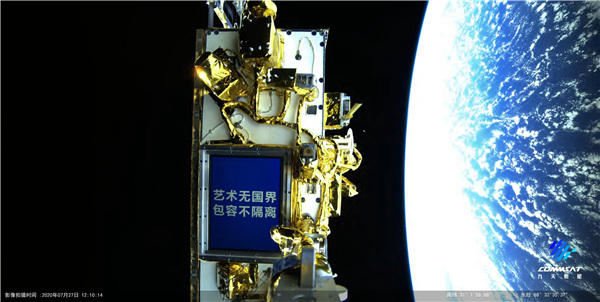
On a hot and clear Thursday night above the city of Xiamen, in Fujian province, an orbiting Chinese satellite continuously spits out flashes of light that taken together constitute a Morse code message strung across the heavens. "Second Luminous Festival Amoy", it reads, referring to the opening of the festival in Xiamen that evening, Amoy being the name of the city in local dialect.
The festival is a nonprofit one held annually since last year that focuses on inclusive arts. With forums, performances and workshops, it aims to provide an artistic platform for minority groups, reduce prejudice and promote exchanges and friendship between different social groups.
Putting that celestial show on July 23 into context, Ge Huichao, founder of the festival, says: "inclusiveness is just like the starry sky, with different social groups looking at one another and illuminating one another".
This year's festival, from July 25 to Aug 8, advocated "art without borders, inclusiveness without isolation", aiming to encourage people to think about inclusiveness, particularly in the light of the dislocation caused by the COVID-19 pandemic.
At an opening forum, professionals from supporting organizations and social welfare institutions discussed their work in promoting inclusiveness through art and culture, highlighting diverse social groups, including people with disabilities and senior citizens.
Zhang Lie, director of the autism rehabilitation research project, Institute for Accessibility Development of Tsinghua University, said the project is working to establish a statistical system that can contribute to the rehabilitation and education of autistic children.
Research in China and elsewhere has shown that 1 in 100 people are autistic, meaning that there are at least 10 million people in China with autism.
Targeting the huge population, nonprofit organizations including the Xiamen Foundation for Disabled Persons, which hosted this year's festival, have been experimenting at using art as a means of rehabilitation.
Lu Ya of the foundation says it has developed six art therapy courses to help children with special needs and to promote social integration.
In each class, two in every three students have learning difficulties, many of whom are affected with autism, and there are enough volunteers to provide one-on-one support.
"Via the medium of art, such as painting and piano, we create a pedagogy of deep participation and an inclusive environment, for these autistic children to connect with non-autistic children, to support each other and share the energy of one another," Lu says.
Their findings show that often children with autism can perform even more actively in these classes than those without autism. When immersed in music or other artistic environments, they can open up and bond with others.
The organization has been developing these art therapy courses for more than three years, working with 11 educational institutions, and with the voluntary support of 48 teachers and 3,565 nonprofessional volunteers. A total of 1,232 children with needs have attended these courses.
This year, for the first time, the foundation worked with Body On &On, a cultural and art organization that founded the festival.
"We plan to continue working with the Luminous Festival, for we have been exploring the art integration courses, and have achieved satisfactory results," says Chen Yiyu, secretary-general of the foundation.
"Moreover, I believe any cause requires support from society at large, and we hope to establish links with more organizations and promote integration and inclusiveness."
Apart from art therapy courses, the organization has established a comprehensive system, including disability prevention, rehabilitation, career support and social integration.
This year's Luminous Festival was conducted both online and offline, with the forum and lectures hosted via video calls, performances screened or livestreamed, and workshops that reached into the local communities of Xiamen being held.
Accessibility was one of the top priorities for all events. An English-Chinese simultaneous interpreter and a sign language interpreter were present at each session, and transcriptions of speeches were produced in real time.
"Inclusiveness should target the general public rather than people with special needs only," Ge says."Tolerance and integration require a two-way effort, otherwise people with needs will remain invisible in society. We need to be able to see each other."