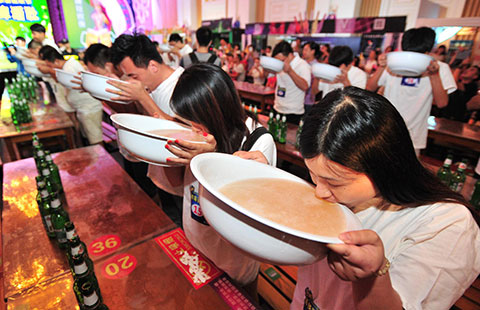
Ningbo, an affluent city in East China, is encouraging what it calls "social forces" - private entities - to engage in the cultural sector, in an effort to break from the traditional model in which most cultural events, such as concerts, operas, exhibitions and sports matches, are funded by governments.
"Ningbo has many cultural entities that would like to participate in such. From the government's perspective, we need to support and guide them into the arena through preferential policies," said Chen Sanjun, director of the culture and art department under the Ningbo Committee of the Communist Party of China's publicity bureau.
Ningbo boasts a strong private business base, with one in four local people involved in export-related industries.
Various reasons have motivated private entities to step into the cultural sector. Philanthropy, commercial profit and personal preferences have all played.
Wang Zhaochun, chairman of HKE Holding Group, a local private entrepreneur, is a prime example of the dynamics behind the phenomenon.
Wang, 45, made his first fortune in the electronic components business at a young age, though he never attended college. He said that after reaching financial freedom and creating a self-sustaining business, he aspired to achieve something beyond material abundance.
His interests in painting, photography, music and astronomy, which he developed in childhood, reawakened and guided him to an arena he was passionate about.
He initially devoted his spare time to getting a private pilot's license, learning horsemanship, driving racing cars, diving and adventure tourism, including an expedition to the North Pole. However, in time, he felt he wanted to do something that not only entertained himself, but also helped others.
He then allocated three floors of a building his company was constructing for a fine arts museum, a concert hall and an astronomical observatory. He invites lesser-known painters to exhibit works and introduces them to potential buyers. He also organizes musical events to bring renowned artists to Ningbo people. This month, he invited virtuoso Chinese pianist Lang Lang to play at the hall, he said proudly.
All the events are paid for by Wang.
"Ningbo is known elsewhere for an abundance of garish millionaires and lack of culture. Ningbo businessmen are spoken about as 'making money in the daytime and counting money during the nighttime'. I want to change that perception," he said.
Wang said he now spends almost all of his time on cultural affairs, but it is rewarding and he has made many friends in the arts. His efforts are greatly welcomed by the government and he has found the spiritual fulfillment he had long been seeking.
"Though they are still rare, private entrepreneurs are increasingly willing to take part in culture," he said.
Private businessmen are not the only participants in culture in the city. The Ningbo Culture Square Development & Investment Co represents another strong force - State-owned enterprises.
The company, a subsidiary of a much larger State-owned conglomerate, has invested in a "culture square", where it has hosted many events.
The commercial complex is now home to various cultural brands, such as CJ CGV, the largest multiplex cinema chain in South Korea, and Langham Place Hotel, a boutique hotel brand under the European Langham Hospitality Group. The square just hosted a two-month-long citizen cultural festival.
"Public cultural events are not necessarily free, but if not, they can still be affordable," said Wei Xuemei, chairwoman of the company. There are tickets under 100 yuan ($16) for each event organized by the company.
Although such events cost money to run, the company is compensated by the extra customers attracted by the events, Wei said. Maintaining high visitor numbers is key for China's commercial property operators to charge market rents.
"Social capitals' participation in cultural undertakings should be sustainable, so it is vital that it is commercially sustaining," Wei said. "What's more, as private operation is much more efficient, it saves some money for the government even if the project itself runs at a slight loss."
Contact the writer at zhengyangpeng@chinadaily.com.cn


Copyright 1995 - . All rights reserved. The content (including but not limited to text, photo, multimedia information, etc) published in this site belongs to China Daily Information Co (CDIC). Without written authorization from CDIC, such content shall not be republished or used in any form. Note: Browsers with 1024*768 or higher resolution are suggested for this site.
License for publishing multimedia online 0108263 Registration Number: 130349