The chances of students pursuing higher education have grown with the college admission rate reaching 80 percent. That's why the proposed change to the college entrance exam (gaokao) is no small matter. It wouldn't be exaggeration to say that it will have an impact on the lives of millions of Chinese families.
The Decision on Major Issues Concerning Comprehensively Deepening Reforms, issued by the Third Plenum of the 18th Communist Party of China Central Committee, emphasizes the reform of gaokao and the college enrollment system. As Minister of Education Yuan Guiren said, the gaokao reform is a crucial part of the comprehensive reform of the education sector.
High school students get only one chance to crack gaokao, which for all practical purposes determines their future. The plenum decision, to be implemented through a series of measures, is expected to solve the problem of one single exam deciding the future of a student.
There is need to stick to the current exam-free compulsory nine-year education system while making efforts to promote comprehensive quality evaluation of students and their enrollment in vocational schools. There is also need to establish different admission systems based on two major comprehensive evaluation indexes - unified gaokao results and academic proficiency in high school exams - explore the possibility of reducing the number of subjects in gaokao, holding multiple exams in a year for admission to colleges and launching pilots that allow credit transfer among universities. Besides, vocational colleges and colleges for adult education need to admit students of all ages.
China's college enrollment system lays too much emphasis on the screening and selection procedure for gaokao and makes gaokao scores the only standard to evaluate students and schools. In the process, the authorities ignore students' academic performance in schools, their overall personality development and contribution to their schools and society. This has harmed quality-oriented education.
Multi-dimensional evaluation, the highlight of the proposed education reform, is designed to help foster the belief that "everyone could be a talent", and to respect individual's choice, encourage individual development, follow no set patterns for selection of talents, and replace the old selection-driven exam pattern with new evaluation concepts, contents and methods to assess students on a comprehensive and multi-dimensional basis.
Academic proficiency exams, aimed at evaluating how good high schools are at teaching the mandatory subjects, can help students develop a balanced knowledge structure. In comparison, comprehensive quality evaluation is an overall assessment of a student's morality, intelligence and physical health. In other words, it is a more comprehensive assessment of a student's potential in terms of academic excellence, innovation and social adaptability.
But certain problems have to be dealt with caution, because restriction-free admission to colleges could, given the current lack of supervision and restraint mechanism, breed corruption. Media reports have exposed the misdeeds of Cai Rongsheng, former head of the student enrollment and employment division of Renmin University of China. Cai was detained in Shenzhen, Guangdong province, while he was trying to flee to Canada with a forged passport and was reportedly found to be part of a corruption scandal involving hundreds of millions of yuan.
To prevent corruption, therefore, a professional enrollment committee needs to be established in colleges offering restriction-free admission. The existing administration-led enrollment system has to be changed, because one person cannot be in charge of admissions. Also, a more sound supervision and complaint-lodging mechanism has to be established; it should be open to social supervision and transparent on admission information. More importantly, a modern university system must be developed to restrict universities' administrative powers, make the admission process autonomous and guarantee academic independence.
It is understandable that people are worried that combining the humanities and science streams in gaokao could increase the already heavy burden on high-school students. But people should know that the combination, by exposing students to the two streams, is perhaps the best way to ensure their all-round development. Before jumping to hasty conclusions on the proposed reform, people should see objectively the problem of heavy homework load that high-school students have to bear.
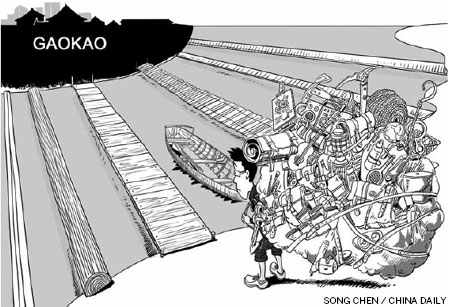
The gaokao-centered outlook of students and parents has become a chronic disease. Some schools have changed their teaching schedules to help students excel in gaokao. The result in most cases has been repetitive exercises. Already heavily burdened final-year high-school students spend a lot of time on meaningless rote learning and mechanical drills. At best, they can be called "exam machines". That's why the reform aims at reducing the burden of homework for students.
If schools offer a scientific range of subjects, properly arrange the teaching schedule and cancel classes for mechanical learning, it would reduce students' burden and give them more free time to pursue the subjects they are genuinely interested in and develop their personality, which would ultimately help improve their knowledge structure and improve their overall academic and individual quality. All these require a change in people's mindset. As a beginning, we could include some other factors, along with gaokao scores, to gauge the true potential of a student seeking admission to a college.
The author is an associate researcher at the Research Center for International Comparative Education, affiliated to the National Institute of Education Sciences.
(China Daily 12/05/2013 page9)

Copyright 1995 - . All rights reserved. The content (including but not limited to text, photo, multimedia information, etc) published in this site belongs to China Daily Information Co (CDIC). Without written authorization from CDIC, such content shall not be republished or used in any form. Note: Browsers with 1024*768 or higher resolution are suggested for this site.
License for publishing multimedia online 0108263 Registration Number: 130349