BEIJING - China has announced plans to halve the number of industries in which it restricts foreign investment, a move to further open up the market of the world's second-largest economy.
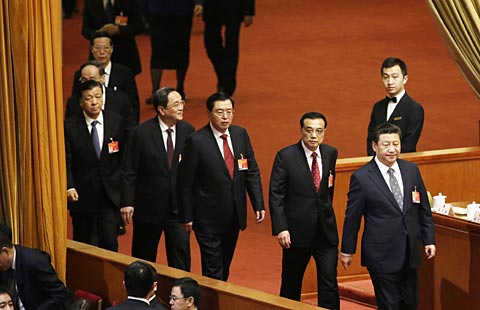
China will improve how it regulates foreign investment and create a "stable, fair, transparent and predictable" business environment, said Premier Li Keqiang while addressing national legislators Thursday morning.
The premier said at the opening of the Third Session of the 12th National People's Congress, China will revise its Catalogue for the Guidance of Industries for Foreign Investment, which governs restrictions on investment from abroad, and make the service and manufacturing sectors more accessible.
"We must carry out a new round of high-quality opening up and move more swiftly in building a new open economy," said Li, without providing details on when or how the revisions to the Catalogue will be made.
"Making more sectors accessible shows China's commitment to opening its market to overseas investors," said Long Guoqiang, vice director of the Development Research Center of the State Council.
In November, the National Development and Reform Commission solicited public opinions on revising the Catalogue.
According to the draft list, plans have been made to open sectors including steel, ethylene, oil refining and white spirits to foreign investment.
Diageo, one of the world's leading alcoholic drinks businesses, welcomed the prospect of widened access to China's liquor market. Diageo bought China's Sichuan-based liquor brand Swellfun in 2012.
"We are confident of the white spirits business in China and will invest more in Sichuan," said James Rice, general manager of Diageo's Sichuan Swellfun Co.
Foreign direct investment (FDI) in China topped the world last year with 119.6 billion U.S. dollars, while China's overseas direct investment reached 102.9 billion U.S. dollars.
In 2014, the number of new foreign-funded companies increased by 5.76 percent to hit 38,400, according to the State Administration for Industry and Commerce. The rise reversed consecutive drops in the previous two years.
Although some multinational companies have moved their factories out of China to other countries, they are mostly in low-end industries.
Former Commerce Minister Chen Deming noted a 7.8-percent surge in FDI in the service sector last year.
"Foreign investment in China will be generally stable, but the country should optimize the foreign investment mix," Chen said. "Improving the foreign investment list and ushering in a bigger inflow of foreign capital are important."
"Shortening the list of restricted sectors shows the government is moving towards a management based on negative lists," Chen said, referring to the method of employing lists of only banned practices.
The negative-list management has gained traction in China after being promoted in the Shanghai Free Trade Zone since its establishment in 2013.
The number of sectors in which foreign investment is restricted in the Shanghai zone was reduced to 139 last year from 190 in 2013. The length of this year's list is expected to be shorter.
"As China adopts the negative-list management that promises a higher degree of openness, foreign countries will in return open their markets wider to China," Chen said.
James Zimmerman, chairman of the American Chamber of Commerce in China, said to Xinhua, "We look forward to seeing details of the revised catalogue and streamlining measures, and share the premier's hopes for a stable, fair, transparent and predictable business environment in China."
"Recent positive trends have raised the expectations of current and potential foreign investors in China for inbound investment reform and opening," Zimmerman said.
In contrast to Chinese firms' usual strategy of beating foreign competitors on price, the government is rolling out policies to encourage firms to participate in overseas infrastructure development projects to move the country's exports up the value chain.
Chinese leaders have promoted the country's railway technologies in foreign countries, such as Angola where the China-made 1,344-km railroad project was put into operation.
China will also encourage its companies to win more global market share in electric power, communications, engineering machinery, automobiles, aircraft and electronics.
Related Stories
Copyright 1995 - 2015 . All rights reserved. The content (including but not limited to text, photo, multimedia information, etc) published in this site belongs to China Daily Information Co (CDIC). Without written authorization from CDIC, such content shall not be republished or used in any form. Note: Browsers with 1024*768 or higher resolution are suggested for this site.
License for publishing multimedia online 0108263 Registration Number: 130349