 |
|
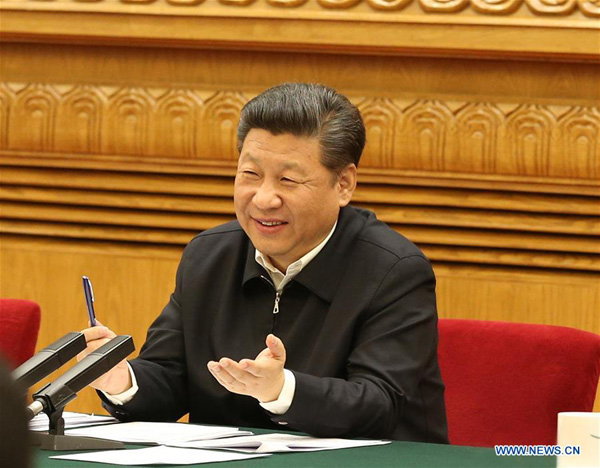
President Xi Jinping, also head of the central Internet security and informatization leading group, presides over a symposium on cyberspace security and informatization in Beijing, April 19, 2016. [Photo/Xinhua] |
Cyber affairs, especially issues related to cybersecurity and informatization, have become one of the most important areas on the strategic agenda in China-US relations. To ensure the strategic stability between these two great powers on the issue, media outlets have a special responsibility: by correctly representing each country's policy, it can contribute a lot to mutual understanding. On the other hand, misreading could also damage the strategic relationship when it comes to cyber affairs.
A latest example is NYT's misreading of Xi Jinping's view on cyber affairs in his address delivered on April 19, 2016. On May 16 this year, The New York Times published a report titled China Quietly Targets U.S. Tech Companies in Security Reviews, claiming that US companies, including Apple, are facing unfair treatment in China's Internet domain.
The article continued in the same tone the NYT has been using in the past two years, and its two authors, Paul Mozur and Jane Perlez, cited President Xi's remarks at a symposium on cybersecurity and informatization on April 19 as proof.
The authors used this quote by President Xi: "One viewpoint holds that we must close ourselves off, make a fresh start, thoroughly shake off our reliance on foreign technology and rely on indigenous innovation to pursue development."
To show that their report was balanced, the authors also took another of Xi's quotes: "Which things can be imported but have to be secure and controllable; which things may be imported, digested and absorbed for re-innovation; which things can be developed in collaboration with others; and for which things we must rely on our own strength and indigenous innovation."
It's understandable that if companies trust the NYT, they would believe that China will take measures that are not in line with the market economy to target foreign companies, and that China will carry out measures behind closed doors. If so, the foreign companies will become nervous.
However, the NYT completely misrepresented President Xi's views.
First, the NYT article replaced Xi's "No" with "Yes".
Xi's complete quote was: "Now, we have to pay attention to two viewpoints on the technology development. One viewpoint holds that we must close ourselves off, make a fresh start, thoroughly shake off our reliance on foreign technology and rely on indigenous innovation to pursue development. The other is that we should hold open attitude, and stand on shoulders of giants to develop own technologies. The two viewpoints both have some right points, but they are too absolute and do not have the dialectical view."
The NYT only picked a part of the expression, and focused on "close ourselves off, make a fresh start" line. Then the NYT report replaced Xi's polite "No" to the viewpoints with an indirect "Yes". The reader may have a misperception of Xi's point on the issue after reading the report.
Second, the NYT completely ignored President Xi's welcome to foreign Internet firms in the remark.
Just one paragraph before the sentences quoted by the NYT, President Xi said that the Internet has turned the world into a global village and made the international community become more and more closely interconnected.
Blocking Internet access is not the right way to manage the Internet, he said, stressing that "China cannot and will not shut its door to the world."
Possibly, the NYT article could not quote all of Xi's speeches due to its length. But at least, it should not miss one sentence that was immediately after the quote it chose.
"We welcome foreign Internet enterprises as long as they abide by Chinese laws and regulations," Xi said.
The NYT culled the materials to project something it wanted to project: to "scare" foreign Internet firms, including the US ones, to leave the Chinese market or amplify their doubts and suspicions about the Chinese market.
Third, the NYT doesn't mention President Xi's emphasis on "openness" that he mentioned nearly ten times.
In the remark, Xi elaborated on the relationship between opening-up and independence, stressing that the independent innovation did not mean closing the door to developing on its own and that China should insist on opening-up.
Xi said cybersecurity also relies on an open environment, not a closed one. He added that cybersecurity would be created fairly through international communications, cooperation and interactions, as well as absorbing advanced technologies.
China's top decision-maker held the symposium to stress a strong belief that China will continue to adhere to the reform and opening up, but it seemed that the NYT misrepresented the remarks.
As one of the 10 experts to attend the symposium, after reading the NYT article, I am confused why the NYT misread the remarks. Maybe it was caused by poor reading ability, or lack of understanding how to read such remarks properly due to fierce competition, or a preconceived stereotype in the mind, or some other reasons. It is really a problem worthy of rethinking.
Frankly speaking, according to the strategic importance of cyber affairs, the NYT is not a suitable and reliable source for American ICT companies and individuals to understand China if the misreading is not properly corrected.
A translated version of an article of Shen Yi, deputy director of the Cyberspace Governance Study Center with Fudan University



Copyright 1995 - . All rights reserved. The content (including but not limited to text, photo, multimedia information, etc) published in this site belongs to China Daily Information Co (CDIC). Without written authorization from CDIC, such content shall not be republished or used in any form. Note: Browsers with 1024*768 or higher resolution are suggested for this site.
License for publishing multimedia online 0108263 Registration Number: 130349