Making Mouth Sounds To Earn A Living
|
Zhang Kui performs the traditional art of kouji on stage.Photos Provided To China Daily |

Hunan performer who is skilled in vocal mimicry seeks to promote traditional art
Zhang Kui first learned he could perfectly mimic the sounds of animals and birds when he was a child, but at first the talent only landed him in trouble.
"One night, at about midnight, I imitated a cockerel's crow and woke up the neighbors," he recalled. "My parents really scolded me for that one."
Yet the 29-year-old, who grew up in Qiyang, an impoverished county in Hunan province, persevered and today is a full-time performer of kouji (literally "mouth skill"), an art dating back at least 2,000 years.
Kouji, a performance that combines oral stunts with singing and joke-telling, was listed as part of China's national intangible cultural heritage in 2011.
"As long as you stick to pursuing your dream, you will realize it - even though it may sometimes look unreachable," said Zhang, who held down jobs as a waiter, gatekeeper and construction worker before receiving training from a kouji master.
Zhang was 15 when his father died in 2003. He decided to drop out of school and joined his uncle's theater troupe in Changsha, capital of Hunan, where he first discovered his skills were suited to the art.
As no one else in the troupe was a vocal imitator, Zhang bought audio CDs to study how to imitate the sounds of musical instruments and animals. He made his stage debut shortly afterward, performing at a small theater in Changning, Hunan.
"Although I wasn't that skilled, I got a lot of applause. It felt so good," he said.
The positive start to his performing career came to a halt when the troupe went bankrupt. He then moved to Guilin, a popular tourist city in the Guangxi Zhuang autonomous region, where he found work as a waiter at a karaoke bar.
One night, the bar organized a Christmas show with vocal stunts on the bill. When his colleagues were in rehearsal, Zhang, who was sweeping the floor, imitated a dog bark that astonished the host, an entertainer named Abin, who decided to give him the chance to perform.
In 2005, Zhang followed Abin to Guangdong province and performed as a mimic outside supermarkets to sell shampoo. "The salary was chicken feed, so I had to perform at bars at night to earn more. The bars paid more, but they didn't invite me often," said Zhang, who also worked as a construction worker to make ends meet.
His big break came in 2007 when he had returned home and found a job as a waiter in a bar. After preparing fruit and milk tea and washing cups for a year, he found an internet listing for an apprentice to Niu Yuliang, a Beijing kouji master.
Zhang sent an audition video and waited about a month before he received a reply from an apprentice, who explained his skills had amazed the master.
His excitement soon died, however, when he realized he didn't have enough money to live in Beijing. Further, he said he failed to win his mother's support.
"You cannot feed yourself by making noises," he recalled her telling him. She also said some of his late father's medical bills were still outstanding.
With just 5,000 yuan ($720) he had borrowed from friends, Zhang went to Beijing and rented a basement room. He worked as a gatekeeper to pay his way and would get up before 6 am to practice his skills for two hours near a canal before heading to work.
He said he insisted on practicing even when the temperature went down to lower than-10C. He went to Niu, the kouji master, on weekends and holidays to learn.
Zhang's skills improved and he has since performed on more than 20 television programs, including on China Central Television and Hunan Satellite TV.
In September 2013, he was invited to Switzerland to perform as part of a cultural exchange program. After working with the Hunan provincial acrobatic troupe in 2014, he performed in Africa, Europe and North America. He tried to imitate sounds with local features. In the Caribbean, for example, he imitated the sounds of sea waves.
Zhang now tries to promote kouji. Last year, he made a short film about the art and said it was the first film on the subject. The film will be released this year, and he said he hopes to draw more attention to the art. He also plans to give lectures at universities.
"Up until now, I could barely make a living from performing the art, but I won't give it up," Zhang said, explaining his biggest dream is to let the world know more about the traditional art.
Wen Xinzheng contributed to this story.
|
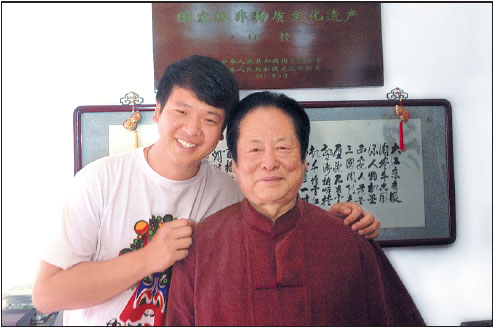
Zhang and his teacher Niu Yuliang, a Beijing kouji master. |