Through paper and pottery, artisans redefine village
 |
|
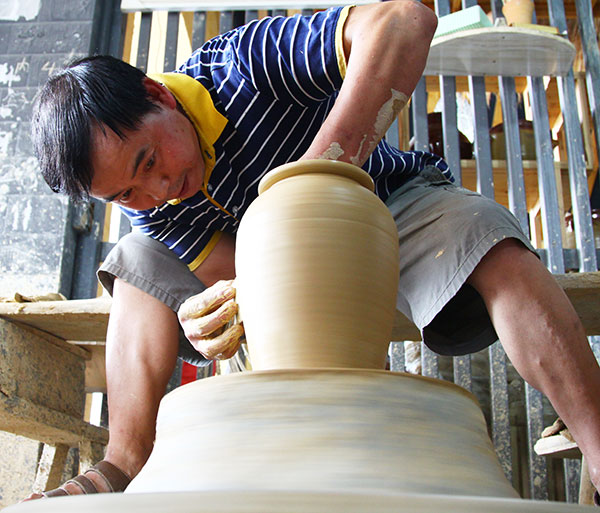
Mu Xiangang, a resident of Huamao village, Guizhou province, works a piece of pottery on a wheel. [Chen Zebing/China Daily] |
Zhang Shengdi, an entrepreneur in Fengxiang, Guizhou province, has been working to revive papermaking-h(huán)er part in the fight against poverty-ever since President Xi Jinping visited Huamao village in June 2015.
Huamao falls under the administration of Fengxiang, which is part of the larger Zunyi city.
To alleviate poverty by developing tourism and cultural industries, the local government has made great efforts to protect traditional crafts such as pottery and papermaking, as well as developing other creative products.
Zhang's company once marketed Moutai liquor. Now she has set up a cultural brand called Hua Mao Ren Jia, which means "households of Huamao".
"President Xi's visit to Huamao drew public attention to my hometown, with the village welcoming many more tourists than ever before since he came here. So I thought it was time for me to ride the growth wave and do something for my poverty-stricken fellow villagers," Zhang, 43, said.
She spent some time with poor families who receive government subsidies and discovered that dependence on subsidies might not be the best answer to make their situation better. She decided to train some people in the village to help with long-term employment.
Making paper by boiling the bark of mulberry trees is an old tradition in the village. Zhang drew up a blueprint to help diversify the products made of paper-notebooks, umbrellas, lanterns-and gave customers an opportunity to participate in the process of papermaking.
"There's an old Chinese saying that goes, 'Teaching a man how to fish is better than feeding him fish,'" Zhang said.
Her papermaking startup gained the support of the village Party committee and the local government. Three houses in Huamao were rented out for the purpose.
"I paint Chinese pictures on paper products to enrich their design," said Wang Peikuan, a member of the Calligraphy and Painting Association of Fengxiang.
"Working on the poverty alleviation project gives me a sense of achievement."
Last month, Zhang and representatives from 13 other cultural enterprises in Guizhou attended the China Beijing International Cultural and Creative Industry Expo, where they promoted their products.
With the help of the local branch of the All-China Women's Federation, she learned about the mass entrepreneurship and innovation drive that China has launched to generate more jobs.
Members of the village committee also used their social networks to find potential customers for her, she said. Developing sales channels, especially online, is a priority now.
"I would like to cooperate with universities in the future to see if young people can give us ideas for product designs," she said.
To find young talent for startups, the local government established the Maker Center in Huamao, where students majoring in visual communication design at Zunyi Normal College interact with local artisans involved in traditional pottery.
Wang Weiqi, a volunteer at the center, said the students' brainstorm about how to turn clay into exquisite pottery pieces so that men and women in the craft can break out of their insularity in designing such works.
They also want to find ways to pass down traditional techniques to the younger generation.
Achieving both within the crafts-inheriting and innovating-is the long-term goal of the village's cultural and creative industry, even though the approach is being used to fight poverty at the moment.
With the help of the government of Fengxiang, Mu Xiangang, 50, a local pottery maker whose workshop was visited by Xi in 2015, has become a pioneer in his ancestral craft. His workshop serves as a base for college students to create artwork out of clay.
Mu also offers tourists the experience of making pottery themselves, at 20 yuan ($3) per person.
He said he uses an electric kiln instead of his old coal-fired furnace now because Xi urged traditional artisans to be environmentally friendly.
"My annual income has increased to 300,000 yuan from 30,000 yuan as tourists flock to my workshop to experience pottery and buy my wares," Mu said of the big change in his life.
"Since President Xi's visit, we have a clearer idea about lifting the village out of poverty. We should try to make papermaking, farming and revolutionary culture the symbols of Huamao. These symbols will strengthen the cultural identity of the village, thereby raising its profile and boosting tourism," said Shuai Bo, Fengxiang's Party secretary.