Canal flows into heart of Tongzhou
 |
|
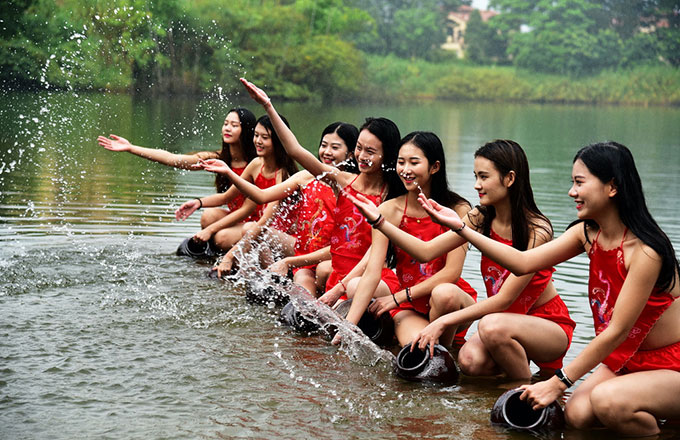
Tourists escape the summer heat at the Grand Canal Forest Park in Tongzhou, Beijing, in July. ZHU ZHENQIANG / FOR CHINA DAILY |
The Beijing-Hangzhou Grand Canal, listed as a UNESCO World Heritage site in 2014, spans over 1,700 kilometers through six provinces and cities, with 42 km in the Tongzhou district of Beijing.
The canal connects central Beijing to its outskirts and then travels south, connecting the Yellow and Yangtze rivers while meandering past several urbanized areas.
On Feb 24, President Xi Jinping visited the Grand Canal Forest Park in Tongzhou, where he was briefed by local officials about its history, the management system and overall environmental protection provided by the district.
At the time, Xi said that Tongzhou has historical and cultural heritages, and to make the past serve the present its resources should be explored, with the Grand Canal at the core. Provinces and cities along the Grand Canal should all take responsibility to protect it, he added.
Xi emphasized the importance of afforestation and the beautification of Tongzhou.
The Tongzhou district leadership took his comments to heart.
History lesson
The canal's oldest section was built as early as the fifth century BC. As for the Tongzhou section, the water transport system enjoyed its heyday during the Yuan Dynasty (1271-1368) and the Ming Dynasty (1368-1644).
However, as Beijing grew and expanded in the 1980s, pollution began to take hold. The water started to smell foul as transportation along the canal stopped. Later, more factories opened along its upper reaches.
"When I was a kid, I always drank the water from the Grand Canal when herding sheep," said Wang Youshun, 57, who has lived near the canal since his birth.
"In the 1980s, the river started to get polluted," Wang recalled. "It turned black first and then started to smell."
The Tongzhou government started to manage the river channel of the Grand Canal and its development in 2013.
In April, an upgrade of the Tongzhou Bishui sewage treatment plant was completed, increasing its processing ability to 180,000 metric tons of sanitary sewage per day from 100,000 tons, according to the Tongzhou environmental protection agency. This has kept pollutants from entering the canal and led to the creation of the Grand Canal Forest Park that Xi visited in February.
River chief stands out
According to Fang Yajun, chief of the water resources bureau of Tongzhou, a river management plan was developed in 2016 under which three levels of supervision — district, town and village — were devised to manage the grand canal.
The river chief has to check sewage outflows due to litter and illegal construction, and clean the banks, surface and bottom of the river. Zhang Hongfeng, Party chief of Zhangxinzhuang village, began as river chief this year. Zhang checks the river two to three times a week, secretively and randomly.
"Some of the industrial enterprises from upriver moved to other locations and some closed down," Zhang said.
"My main job now is to stop tourists from throwing garbage into the river," he said.
If he sees people throwing rubbish on the riverbank, he picks it up and tells them, "Your garbage has dropped and I'm helping you to collect it" to spread the awareness, he said.
Residents of Zhangxinzhuang have voluntarily formed a team of about 30 people to protect the Grand Canal. At about 6 am daily, the volunteers, mostly retirees, start to collect rubbish on their way to exercise along the riverbank.
"All the villagers have my phone number, if they see some problem, they will call me," Zhang said. "But there has been no such call this year."