How overcoming SARS opitomized the city's resilience


 |
|
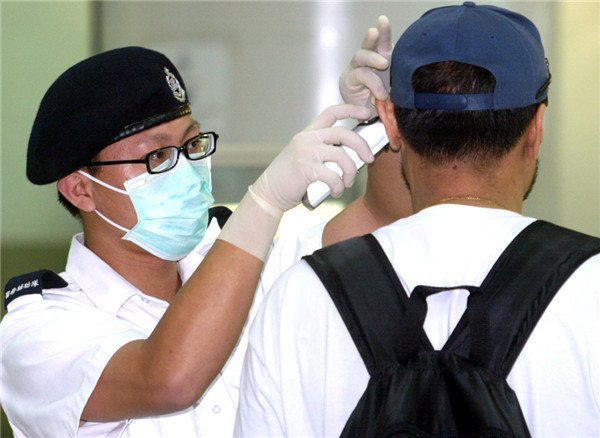
A paramedic checks a man's health during the 2003 outbreak of SARS in Hong Kong.[Photo by Huo Yan/China Daily] |
Important, but hard, lessons were learned during the 2003 outbreak of the deadly virus, as Honey Tsang reports from Hong Kong.
The outbreak of Severe Acute Respiratory Syndrome in 2003 was a life-changing experience for many people in Hong Kong. It changed the world view of both those who survived the often lethal virus and the medical professionals who fought its spread on the front line.
For Dr. Sung Jao-yiu, the experience was a test of his medical knowledge and judgment.
Meanwhile, surviving SARS inspired Thomas Fung - who contracted the virus while providing healthcare to patients - to work in public hospitals and dedicate his career to the welfare of society's less-privileged members.
The battle against SARS was tough. For many in Hong Kong, memories of paramedics in surgical masks sprinting to move the stricken into quarantine are as vivid as if the outbreak happened yesterday.
Legions of colleagues fell gravely ill, the progression from diagnosis to death coming with breathtaking swiftness.
Sung, now vice-chancellor of the Chinese University of Hong Kong, said the images have been embedded in his memory for nearly 15 years, but he has made no attempt to expunge them.
Sung's crucial role in one of the worst catastrophes to strike Hong Kong in living memory, began on March 10, 2003, when SARS erupted suddenly in Ward 8A of the Prince of Wales Hospital in the New Territories, where he was chief of service of the department of medicine and therapeutics.
"The senior nurse told me several colleagues had come down with a fever and had requested sick leave," he said.
That morning, 11 healthcare workers from the ward reported sick with symptoms of respiratory tract infection. It was a bad omen. Sung was alarmed by the threat of a massive outbreak. His fears were borne out by the resulting epidemic.
He ordered Ward 8A to be closed immediately, and had to bear a wave of anger from patients and their family members, who were furious that the ward had been placed in isolation.
No one could have foreseen what was to come.
"We were dealing with a mysterious disease. We had absolutely no idea where it came from, how it was transmitted, or how it should be managed in patients," Sung said.
He stuck with his intuition, which was shaped by experience. In the days that followed, his caution was justified as the number of new cases at the hospital soared.
On March 11, a day after the ward was quarantined, 50 members of the medical staff reported sick, with 23 hospitalized immediately.
The virus spread quickly through the hospital. At its height, 114 healthcare workers, 17 medical students, 39 patients and 42 visitors were affected; 137 of them had contracted the disease from Ward 8A.
"We were fighting in the dark," Sung recalled.
On March 12, two days after the first outbreak was recorded, SARS swept through the hospital's eighth floor. Sung divided the medical staff into "Clean" and "Dirty" teams. The Dirty Team, which Sung led, tended to patients with SARS.
Sung called on colleagues who specialized in infectious diseases to join him, but the recently married and those with children were instructed not to volunteer. "We were not sure what we were handling, or how dangerous it could be," he said.
Ward 8A became the epicenter of the outbreak. Fung, then a medical student at the Chinese University of Hong Kong, was treated there when he contracted the virus.
Fung was among the first group of 23 healthcare workers taken ill. He had been training on Ward 8A, and one of his patients was in the next bed to "JJ", the person later identified as the source of the outbreak on the ward.
As the virus took hold, Fung could feel the first chill; breathing became painful, then the fever came. A lesion was discovered on his lung, and he was quarantined in Ward 8A.
Fung, now 37, has maintained a close relationship with Sung, his university mentor back in 2003, and he has fond memories of medical students gathering at Sung's house, where they enjoyed themselves and chatted about their future careers.
At the height of the epidemic, Sung became the anchor who held the Dirty Team together. Everyone knew the risks, and the high probability of becoming infected.
Sung regularly checked Fung's condition. When treatments such as Tamiflu and antibiotics didn't work, Sung advised Fung to take steroids. Fung was the first person in Hong Kong to receive steroid therapy in the fight against SARS: "I agreed to try because I trusted Song."
The steroids worked. Fung's fever rapidly subsided, the lung lesion disappeared in days, and in just two weeks Fung was out of quarantine.
"I was probably the first SARS patient to leave the hospital," he said.