Luxury retailers follow the money
When high-end Beijing department store Scitech Plaza celebrated its 14th anniversary last year, it eyed Shanxi Province in North China.
In promoting its 25 percent anniversary discount, the store completely avoided metropolitan Beijing and focused its ad blitz on Shanxi, once mostly known for its barren hills and grim coal mines.
As the management correctly gauged, there's more juice in Shanxi's nouveau riche than the salaried of Beijing. Hundreds of Scitech faithful from Shanxi flocked to Beijing, many flying in for the yearly bash. They stayed at an adjacent luxury hotel, also owned by Scitech, and splurged on 14,000-yuan La Mer cosmetics, 20,000-yuan fur coats and 7,000-yuan shoes.
Together with an army of the fellow moneybags from Hebei, Inner Mongolia and Tianjin, the shoppers from Shanxi sent Scitech's sales figures soaring to 20 million yuan on the anniversary day, the store's highest-ever single-day revenue.
Scitech's anniversary strategy reflects a larger trend - wealth spreading from a handful of traditional urban centers such as Beijing, Shanghai and Guangzhou to the so-called second-tier cities, and even obscure small towns.
Pick any weekend and check the license plates at the parking lot of Yan Sha Outlets on Beijing's Fourth Ring Road. You will be surprised how many of those shiny sedans are from out of town, mostly from neighboring Hebei Province. Clearly, for the have-money-will-spend class in second-tier cities, driving to Beijing to shop for luxury brands has become the new Sunday morning pastime.
Shift to smaller cities
The rapidly growing purchasing power and appetite for high-end products in small cities have drawn the attention of top international luxury lines, which are increasingly gravitating to second-tier cities.
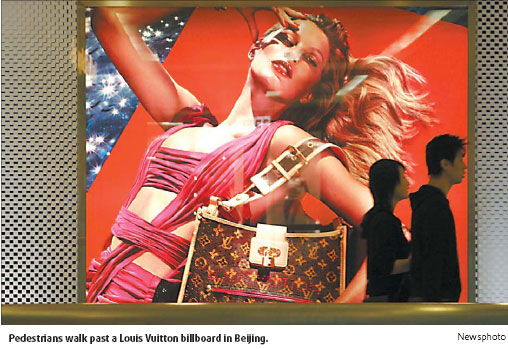
Louis Vuitton, which entered China 15 years ago and has 16 boutiques spread across 13 cities, has opened shops in three new cities in the last two years - Wenzhou, Kunming and Shenyang. The company's next targets are Chongqing, Harbin, Sanya, Suzhou, Ningbo, Nanjing and Urumqi, according to the company's CEO Yves Carcelle.
French luxury giant Hermes chose Kunming, capital of southwestern China's Yunnan Province, to open its first watch boutique in China two years ago, selling timepieces for up to 260,000 yuan each. The following year, it expanded to Anshan, a steel-manufacturing city in Northeast China's Liao-ning Province.
Writing instruments giant Montblanc last year took over all its outlets from local partners and started operating directly, both in first- and second-tier cities.
Hugo Boss' strategy in secondary cities is simple: be the first, according to Lars Larsen, managing director of Hugo Boss Hong Kong Ltd. At the end of April, Hugo Boss had 75 points of sale in nearly 40 cities.
The huge population base in small cities is the main attraction for the luxury segment. China's second-tier cities are huge compared to those in Europe or the United States. Luxury brand executives point out that China has over 100 cities with populations of over 1 million, opening up immense possibilities.
Economic reform has spawned tens of thousands of private entrepreneurs in Zhejiang, Jiangsu, Fujian and Guangdong provinces. In Northeast China's Liaoning, Jilin and Heilongjiang provinces, there is a long tradition of ostentatious consumption. In Shanxi, the ultra rich, mainly mine owners, are known to flaunt their Ferraris and flash their Omegas.
The demand for luxury products has been growing so rapidly in secondary cities that it has already exceeded the level of demand in first-tier cities 10 years ago. If high-end brands were eager to enter major cities a decade ago, it's thus hardly a surprise to see them flock to small cities now, says Liu Wei, chief analyst with Shanghai-based Integration Strategy Consulting Co Ltd.
Social marker
Liu says a new affluent class has emerged in small cities. They have a strong desire for social recognition and want to stand out from the crowd. "What they care about is not necessarily the intrinsic value of the products. All they need is something that's seen as expensive by others, such as Rolex watches and BMW cars," he says.
Chen Zhan, a research director at TNS, a leading international market research firm, agrees. Although the rich in both first- and second-tier cities have a similar longing for luxury goods, those in smaller cities have a vaguer perception of brands than those in large cities, Chen says, with less knowledge about their origins, history and characteristics. What's known and understood, however, is their effectiveness as an immediate social marker.
Still, first-tier cities are still far from saturation. Trend trackers report the emergence of a new breed of big-city consumers they call "understaters", or individuals who prefer more low-profile brands such as Anna Sui and Mac Jacob.
Thus it remains imperative for brands to spread out. One strong factor is rising operating costs, with rentals and wages skyrocketing in cities like Beijing and Shanghai in recent years. It can take several million yuan just to set up a boutique on a main road in Beijing.
Finding new growth areas with low costs tops every brand's agenda, especially for latecomers who have already lost the first round to market pioneers from a decade ago.
It's relatively easy to set up shop in emerging cities. After operating for over 10 years in the main cities, most brands have developed solid networks in distribution, logistics, hiring and staff training, so they can expand to smaller markets more easily, Liu says.
Local governments are game, too. They like to have luxury brands open outlets in their areas as their arrival shows that these cities have arrived.
Fighting piracy is another important factor propelling fashion brands to go to small cities. Fakes are, typically, more rampant in these cities than the top ones. Entering these markets is thus seen as an effective strategy to tackle the problem.
Industry observers say it's hard to tell whether big cities or second-tier ones are more important for business. In big cities, sales growth may be slower as the largest group of consumers is middle-class office workers. In second-tier cities entrepreneurs are the main patrons and sales growth can be much faster, they say.
Yet in terms of management, human resources, market environment, infrastructure and logistics, main cities are still miles ahead.
(China Daily 09/06/2007 page52)