Rise in US tuition fees no deterrent
|
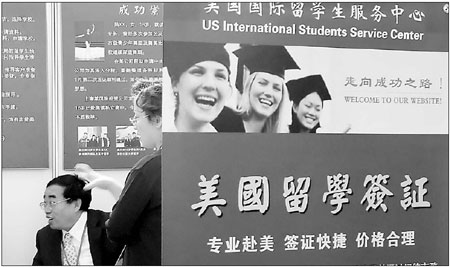
A billboard advertising a US International Students Service Center at the office of a Beijing-based service agent that helps Chinese students to study abroad. Shen Jingwei / for China Daily |
Increasing numbers of Chinese students still enthusiastic about studying overseas
BEIJING - A considerable number of American universities are going to increase their tuition fees for the approaching fall semester. However, the rise has not stemmed the enthusiasm of Chinese students wanting to study abroad. Instead, the desire for an education in the United States has intensified year-on-year.
The number of Chinese students studying in the US has soared from about 98,000 in 2009 to 127,628 in 2010 - a 30 percent increase. For the first time the number of Chinese students in the US exceeds the number from India and is now the largest international students group, according to statistics from the annual Open Doors report released by the Institute of International Education with the US State Department.
Chinese students make up 18.5 percent of international students in US universities at present, said the report.
The fallout from the financial crisis and consequent fiscal contraction means a lot of US public universities are poised for the most dramatic cuts in the history of American higher education. Because many states are facing severe economic difficulties, there will inevitably be significant increases in tuition fees.
"I saw the report on our campus newspaper that fees for the next quarter are likely to rise 32 percent," said Liu Yuyang, a Chinese student at the University of California Los Angeles.
"The tuition fee is currently about $13,000 a quarter, which is already very high for a public university."
The situation is a nightmare for many American families. More than two-thirds of low- and middle-income undergraduates completed their education with a federal loan debt, figures from the US Department of Education showed.
Liu said there were groups of students from the University of California protesting on Los Angeles streets against the rise and saying they were not responsible for the government deficit.
"American universities raise their tuition fees annually. This year some public universities imposed an increase of 15 to 20 percent," said Richard Yang, director of Aoji Enrollment Center of International Education Ltd, a Beijing-based intermediary agency.
However, Chinese families do not seem so bothered. Nearly 80 percent of parents did not consider the issue when they went through the application process, said Yang.
He said the fact that the value of the US dollar keeps falling against the yuan is contributing to rising fees.
"It's rare for international students to receive financial aid from many American universities because they don't have the resources," added Yang.
On average, 6 to 7 percent of undergraduates from outside the US receive scholarships. For graduates the figure is around 10 percent in our experience, said Yang.
Zhang Yonghui, the chief planner of Global Education & Technology Group Ltd, said that the rising number of students studying abroad arose because of the better education system in the United States and the increasing incomes of Chinese families.
"We have a 30 to 40 percent increase in applications every year," he said.
Zhang said that nearly 100 percent of applications for a US student visa have been successful recently. "So long as you get an offer even from a language school, and have certificates of deposit prepared, there won't be any problems."
Claire Chen, who graduated from a Beijing college in June is about to study in the US at Bentley University, a private postgraduate college in Massachusetts. She said pursuing an education abroad is a wise investment.
"The tuition fees are extremely high in our college. However, I am looking forward to getting valuable experience academically and socially. The cost will be worth it," she said.
Experts warned that the growing interest among Chinese in studying abroad is a phenomenon Chinese universities should take seriously. "In order to develop and avoid a brain drain, China's universities need to reform. In essence they need a competitive yet feasible education system," said Pei Minxin, director of the Keck Center for International and Strategic Studies at Claremont McKenna College, California.
China should try to establish small private colleges for undergraduates only. Having private colleges with a high degree of independence will help China to improve the quality of its education and catch up with prestigious Western universities, said Pei.
Zhu Wenqian contributed to this story
China Daily
(China Daily 07/25/2011 page16)