Foreign reserves aren't main cause of inflation, SAFE says
|
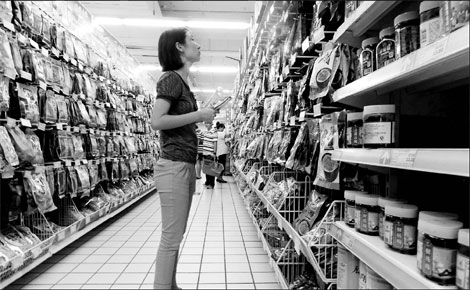
A customer selects snacks at a Beijing supermarket. The consumer price index, a main gauge of inflation, surged 6.4 percent year-on-year in June, the highest level in three years. Mai Tian / For China Daily |
Central bank operations soak up liquidity released by capital inflows
SHANGHAI - Increases in China's foreign exchange reserves aren't the primary cause of continued inflation, the State Administration of Foreign Exchange (SAFE) said in a statement on Thursday.
Inflation has emerged as a major economic problem since last year. The country has tightened monetary policy significantly, changing its monetary stance from "moderately loose" to "prudent" to curb inflation, which the central government sees as closely connected to social stability, its top priority.
But three interest rate hikes and half a dozen increases in the reserve requirement ratio this year have failed to rein in prices.
The consumer price index (CPI), a main gauge of inflation, surged 6.4 percent year-on-year in June, the highest level in three years.
Many economists contend that China's burgeoning foreign reserves, among other factors, play an important role in driving up inflation.
China accumulates the reserves, the world's largest at about $3.2 trillion, because the central bank must buy dollars and other currencies that flow into the economy. It issues yuan in return, because the Chinese currency isn't freely convertible.
Foreign exchange keeps flooding in because China holds a long-term surplus in international payments. But many economists have said that issuing so much domestic currency as a result adds liquidity and pushes up price levels.

Cao Jianhai, a researcher with the Chinese Academy of Social Sciences, told Sohu Focus in April that the yuan issued through the central bank's mandatory foreign exchange settlement regime is the "direct" reason for China's surging inflation.
SAFE said that foreign reserves are not the "major" and "direct" reason for inflation because liquidity released by capital inflows had already been soaked up by People's Bank of China operations such as issuing central bank notes and raising the reserve requirement ratio.
Vikram Nehru, the World Bank's chief economist for East Asia and the Pacific region, told the Wall Street Journal during a news briefing in January that China's inflation shouldn't be blamed on capital inflows, instead attributing it to expansionary monetary and fiscal policies and surging food prices.
In June, food prices, which account for nearly one-third of the basket of goods in the CPI, rose 14.4 percent year-on-year, accelerating from a rate of 11.7 percent in May.
"In China, capital controls work quite well, so I don't think you can blame capital inflows for China's inflation," Nehru said.
Wang Jianhui, chief economist at Southwest Securities Co Ltd, said current inflation conditions mainly resulted from loose monetary policies adopted during the financial crisis to avoid a recession, including a 4-trillion-yuan ($615 billion) stimulus package.
SAFE also said the mandatory foreign exchange settlement regime was "history" and had nothing to do with the increase in foreign reserves.
Under that system, companies were required to sell 100 percent of their foreign-exchange earnings to the central bank. The system began to change in 2002, when restrictions on opening foreign-exchange accounts were eased.
In 2007, companies were allowed to retain foreign exchange within China for business purposes; starting in 2008, they could retain it for any reason.
As of this year, companies could retain foreign exchange outside China.
China Daily
(China Daily 07/29/2011 page14)