Cross-border yuan policy set for stability during 2012
BEIJING - China will aim for stability this year in terms of its policies on cross-border yuan-denominated business, and the nation will focus on implementing current measures rather than introducing new ones, a senior central bank official indicated on Tuesday.
Wang Zuogang, director of the cross-border yuan business division at the People's Bank of China (PBOC), made the comments at a forum in Beijing held by the Bank of China Ltd (BOC) and the 21st Century Business Herald newspaper.
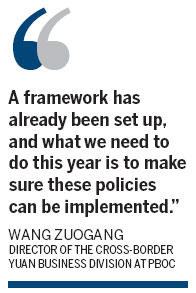
"A framework has already been set up, and what we need to do this year is to make sure that all these policies can be implemented smoothly at the level of enterprises as well as commercial lenders, to serve the purpose of facilitating trade and investment."
In August, the government said it would expand cross-border trade settlements from 20 provincial regions to the entire country.
In October, China allowed foreign investors to make direct investments with yuan legally obtained overseas.
Although no major regulatory change was expected this year, Wang added that the PBOC might refine the system, which allows only about 60,000 enterprises to settle cross-border export trade in yuan, to promote the currency's internationalization.
China should further expand the yuan's global use to counter exchange-rate risks, with the world economy subject to increased uncertainty and major countries still in the shadow of recession, said Chen Siqing, vice-president of BOC.
Zhu Haibin, chief China economist at JPMorgan Chase & Co, said the prospects for China's plan to float the yuan globally were still bright as the currency is expected to further appreciate in the next one or two years.
"The yuan showed ups as well as downs in recent months and the appreciation expectations are not as strong as before, but the currency will continue to appreciate, although at a slower pace," Zhu said.
But there might be trouble in the longer term for the yuan's internationalization, because it relied too much on expectations of a stronger Chinese currency, he said.
"Once the expectations disappear, it's hard to say whether the currency will float more widely worldwide."
Disputes over whether the government should extend cross-border yuan business to an even wider area have developed, as capital flows showed volatility and investor confidence in the yuan's appreciation declined.
China's foreign-exchange reserves declined on a quarterly basis for the first time in more than a decade in the fourth quarter of 2011.
Further, the decline in lenders' yuan positions for foreign-exchange purchases expanded from 20 billion yuan ($3.17 billion) in October to more than 100 billion yuan in December, indicating accelerating capital outflows.
As foreign capital withdrew, however, yuan-denominated capital inflows surged, raising questions about the effectiveness of the authorities' efforts to make the yuan a global currency.
Guan Tao, director of the international payments department at the State Administration of Foreign Exchange, said the rising yuan inflows represented a "normal phenomenon" in the offshore market, and inflows and outflows would be more balanced in the future.
He said that in 2010, the yuan-denominated capital that flowed into the mainland was equivalent to just 19 percent of the capital that flowed out, while the ratio rose to 46.3 percent in 2011.
From September to November alone, the ratio hit 149 percent, which means that the amount of yuan that "came home" outweighed the amount that went overseas.
Yuan internationalization would forge ahead, and there might also be more emphasis on domestic financial sector reform, said Liu Ligang, head of Greater China economics at ANZ Banking Group.
"As China gradually liberalizes its domestic financial markets and opens up its capital account, a gradual convergence of onshore and offshore interest rates and exchange rates can be expected," said Liu.
"By that time, the yuan will also become a global reserve currency."
China Daily
(China Daily 01/18/2012 page15)