Reforms are a shot in the arm for capital's healthcare system
End of medicine price markups puts focus on provision of better services, Li You reports.
Beijing will put a new medical care reform plan into effect on Saturday, which will bring an end to medicine price markups, according to local officials.
More than 3,600 medical institutions are involved in the reform and all of them will abolish the medicine price markups, according to Fang Laiying, head of the Beijing Municipal Commission of Health and Family Planning.
It is estimated that the cost of treatment per outpatient will be reduced by about 5 percent on average thanks to cuts in medicine prices, while there will be an average cost increase of 2.5 percent for inpatient treatment due to the growth of certain service charges, according to Fang.
Community hospitals and medical institutions will be given the same access to the medicines usually prescribed in higher-level hospitals, so that patients will have more choices, Fang said.
Marking up medicine prices is a practice that has been adopted by most public hospitals in China since the 1950s. It allows hospitals to sell drugs with markups usually at a rate of 15 percent above the drugs' tag prices.
Its purpose was to make up for the shortage in healthcare funding from the government, and it became part of doctors' salaries, creating incentive for doctors to over-prescribe.
In 2015, incomes from checkups, tests and medical treatment materials accounted for about 66 percent of the city's medical services revenue, while the incomes from the intelligence and labor of medical personnel, such as diagnosis, surgery, treatment and nursing, which are closely related to the quality of medical services, only accounted for 34 percent, according to Fang.
"The core of this new reform is to separate the functions of medical services and drug sales so as to shut down the markup mechanism in public medical institutions in Beijing," Fang said.
"The separation will cut off the channel for making money through over-prescription and help medical practitioners provide better treatments and other services," Fang said.
"The reform will effectively motivate the medical staff to pay more attention to the medical service they are providing, and further improve the doctor-patient relationship," said Li Ruifeng, a medical reform expert from Beijing University of Chinese Medicine.
Medical service fee
Another major change brought about by the reform plan is the cancellation of the registration fee and consulting fee, which will be replaced by a single medical service fee instead.
It embodies the intelligence and labor value of doctors, nurses and other medical personnel, creating a boost to the provision of better medical services, said Fang.
Third-level hospitals - the highest-level public hospitals in China - for example, will charge a medical service fee for outpatient services offered by its general practitioners of 50 yuan ($7.26) per instance, for associate chief physicians 60 yuan, for chief physicians 80 yuan, for renowned experts 100 yuan. The registration and consulting fees combined were less than 20 yuan.
For those patients who need emergency treatment, they should pay 70 yuan per instance, and the medical service fee for an inpatient will be 100 yuan per bed per day.
"Most of the doctors in our hospital are optimistic about the medical reform, we are expecting higher income in the following days," said a doctor from Beijing's Chaoyang Hospital, who asked to remain anonymous. The hospital is one of the third-level public hospitals in Beijing.
To ease the burden of the public for the medical service fee, the Beijing Human Resources and Social Security Bureau renewed its medical insurance policies, making the medical service fee reimbursable in the basic medical insurance systems for urban employees as well as urban and rural residents.
Price changes
Besides the medical service fee that is correlated with doctors' incomes, the prices for general healthcare services, ranging from beds and nursing, medical imaging examinations such as CT and MRI scans, to traditional Chinese medicine, surgery and other treatments, will also have major changes, according to the Beijing Municipal Commission of Health and Family Planning.
The general reform principle for those items is to increase the prices for beds, nursing, surgery and traditional Chinese medicine treatment, while reducing the prices for physical examinations using medical equipment.
For example, the price of common-level nursing for patients confined to a bed will be increased from 7 yuan to 26 yuan, appendectomy surgery from 234 yuan to 560 yuan, and acupuncture from 4 yuan to 26 yuan per session.
CT scans will drop from 180 yuan to 135 yuan, an MRI scan from 850 yuan to no more than 600 yuan, and a PET/CT scan from 10,000 yuan to 7,000 yuan.
Fang said the price reform of healthcare services involves 435 items. Medical imaging examinations account for 42.5 percent of the total number, general healthcare services 28.7 percent, traditional Chinese medicine services 22.1 percent, surgery and other physical treatments 6.7 percent.
He said that part of the costs of most of the 435 items will now be reimbursable, making the costs more affordable for patients.
Fang said community medical institutions will also be equipped with more drugs for chronic diseases, such as hypertension, diabetes and cardio-cerebrovascular diseases, offering more convenience for residents.
Similar medical care reforms will be promoted to all public medical institutions in China by the end of this year, according to the National Health and Family Planning Commission, China's top health authority.
Contact the writer at liyou@chinadaily.com.cn
|
|
|
|

|
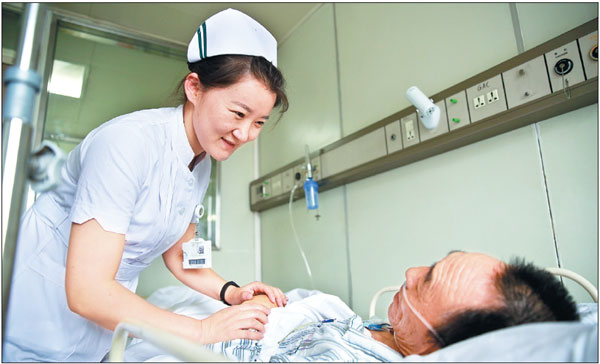
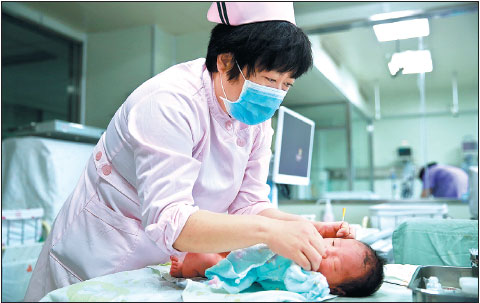
Treatment of newborn babies will now be reimbursed under Beijing's basic medical insurance system after the new plan comes into effect on Saturday.Feng Yongbin / China Daily |
(China Daily 04/07/2017 page7)