Bayer helps to improve healthcare in China
Through 10 years of training and support, the Go West Project has advanced medical capabilities in county-level hospitals, Li You reports.
This year marked the 10th anniversary of the Go West Project, a joint medical training program initiated by Bayer, a global enterprise in life science, and the National Health and Family Planning Commission, China's top healthcare authority.
The project was launched in 2007 to improve medical practitioners' diagnosis and treatment capabilities for common diseases, as well as to support hospital management capabilities for doctors and executives at county-level hospitals in western China.
The project had trained more than 35,000 doctors and hospital executives in 26 provinces and autonomous regions by the end of 2016, according to an evaluation report by the China Health Economics Association.
Over the past decade, the Go West Project has made tangible contributions to the State's policies and action plans, the graded healthcare system, local healthcare services and the service capabilities of medical institutions at the county level, said Zhao Kun, vice-chairwoman of the China Health Economics Association.
"The project has also played a pivotal role in nurturing healthcare professionals for rural areas in China's western regions," Zhao said.

Bayer's business links with China date back to 1882. As a leading global company in the fields of healthcare and agriculture, its classic aspirin has a history of 120 years.
"We are determined to further enhance our commitment to China in support of improving the country's healthcare services, to bring better lives to Chinese patients," said Jiang Wei, managing director of Bayer Pharmaceuticals China.
New opportunity
Ma Shicui is a doctor working in the emergency department of a county hospital in Yimen, in Southwest China's Yunnan province.
There was a defibrillator, a piece of life-saving equipment for irregular heart rates, in her hospital, but few doctors knew how to use it.
Once Ma was given the opportunity to study in the Go West training project, she grasped the technique of using a defibrillator and has saved patients' lives time and time again.
"Thanks to Bayer's Go West Project for building such an excellent platform for medical training. With that training, I became confident," Ma said.
Ma's medical background is common in rural hospitals in western China. As medical resources are not equally distributed between rural and urban areas, doctors in some rural hospitals need better medical facilities and training.
Sponsored by Bayer, the Go West Project runs under the support of medical affairs and international health authorities from the National Health and Family Planning Commission and the National Institute of Hospital Administration.
Academic institutions, universities and hospitals in local regions host the training sessions.
According to the China Health Economics Association's report, the period between 2007 and 2010 saw the first stage of the program provide medical courses to hospital physicians mainly practising in western China.
From 2010 to 2016, the project expanded to some of the central regions.
The key content of medical care training was supplemented with hospital management classes.
Since 2016, the project has been spread to the central and western regions, delivering additional training classes for specialists.
The teachers in the project consist of government officials, doctors from hospitals, professors from universities and some experts from social organizations and enterprises.
Their trainees range from top managers, mid-level managers and cadres, to the top doctors and specialists at the county hospitals.
Considering the social, economic and cultural diversity, as well as the differing medical development rates among the 26 provinces and autonomous regions, the project tailored the training content for the trainees based on their different areas' needs, which is supposed to be a big challenge for its organizer, according to Zhao.
Graded system
In March, Vice-Premier Liu Yandong said in a teleconference that the graded diagnosis and treatment system should be further promoted to push medical resources from big hospitals into lower-level units.
"The decisive factor of the graded diagnosis and treatment system in rural areas is the county hospital, to let them build up an orderly medical service system," Zhao said.
Zhao said the system should ensure that 90 percent of patients receive proper medical service within their own counties, which will require more capable healthcare providers.
It also means that when patients are transferred from higher-level hospitals, the healthcare providers in lower-level hospitals would be able to treat them, Zhao added.
Jiang said that high-quality medical resources are currently concentrated in large cities and large hospitals, and that healthcare infrastructure is crucial for realizing the graded diagnosis and treatment system.
Therefore, he said, better county-level or lower-level hospitals should be built, in terms of infrastructure, management capabilities and their overall strategies.
As an international company, Bayer understands this special part of the Chinese market.
"In addition to the efforts made by the government, it also requires the efforts of all walks of life in cultivating medical talent," Jiang said.
For the next phase, Bayer will consider expanding the range of their project, from county-level hospitals to community healthcare facilities.
Furthermore, the project will not only cover medical treatment training but put more emphasis on training relating to financial management and doctor-patient communication.
"Going forward, Bayer will further align our products and solution offerings with the increasing and evolving patient needs and expand our local partnerships, ultimately contributing to achieving the goals set out in the Healthy China 2030 Plan," Jiang said.
The Healthy China 2030 Plan is a national program proposed by the central authority for improving China's healthcare sector in the next 14 years.
Contact the writer at liyou@chinadaily.com.cn
|
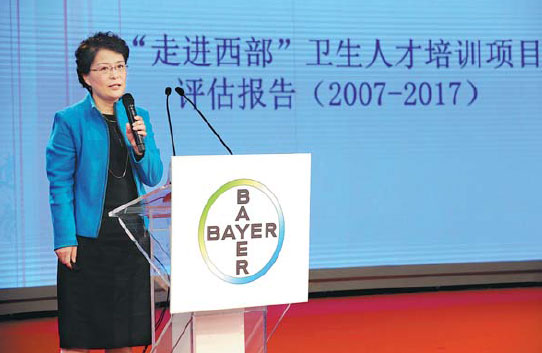
Zhao Kun, vice-chairwoman of the China Health Economics Association, gives an overview of key achievements of the Go West Project over the past 10 years. Photos Provided To China Daily |
|
Trainees of Bayer's Go West Project have used their learned knowledge to serve patients' needs at county-level hospitals. |

(China Daily 04/17/2017 page18)