|
|
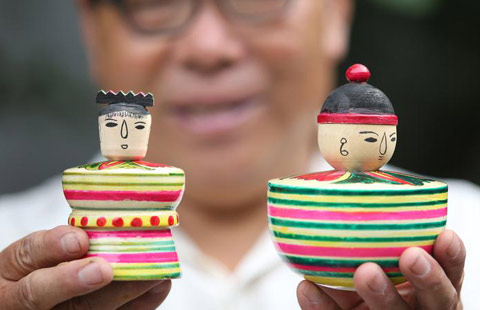
Xu Ernan (first from left), the inheritor of Zhejiang's Haining Shadow Play tradition. [Photo/Long Wei/Xinhua] |
For the first time, folk craftsmen and artists from all over China have received national recognition for passing down their traditions.
The Chinese National Academy of Arts presented the Xinchuan Award to 60 inheritors of traditional Chinese culture recently. They were selected from 1,488 national-level inheritors of intangible cultural heritage, named by the Ministry of Culture since 2007.
"Inheritors of traditional culture are creators of history, although their names have often been missed by history books," says Liu Kuili, president of China Folklore Society. "We should pay tribute to them because their works benefit our descendants."
The awardees include experts in various fields, like Peking Opera, vinegar making, traditional medicine, paper-cutting, wood sculpting, ceramic making and embroidery.
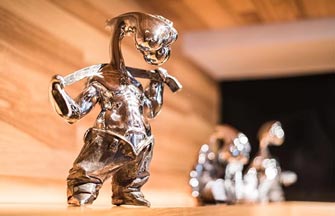
Xinchuan, which literally means the continuum of firewood, is a symbol in Chinese culture for the handing down of skills or tradition. The winners of the Xinchuan Award were nominated by the intangible cultural heritage safeguarding centers of each province, municipality and autonomous region, and decided by a jury of experts. Each awardee receives a certificate, an award cup and a prize of 20,000 yuan ($3,140).
Wen Guiyuan, an 80-year-old folk singer from Mashan in South China's Guangxi Zhuang autonomous region, says he will use the prize to print textbooks for his students.
The Zhuang folk songs of Mashan are imbued with harmony based on three vocal parts. The songs are often heard at ceremonies, such as weddings, funerals and birthday banquets.
As more young people leave home for jobs in more developed areas, the number of Mashan folk singers has gradually been decreasing. To better preserve and transmit the folk songs, Wen began to voluntarily teach students at his home since 2007.
Mashan folk songs were traditionally taught orally, but Wen compiled textbooks with scores and lyrics to make it easier for people to study the different parts of the songs.
Wen's music class has received subsidies from the local government but not on a regular basis. Wen says some financial support will ease his work.
"I don't want these traditional songs to be lost," Wen says. "I will continue to spread the songs, until I my last breath."
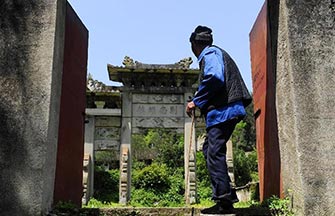
Compared to Wen, Yu Yougui, a 48-year-old wood sculptor from Wuyuan, East China's Jiangxi province, is in a better economic situation because wood sculpture has become collectible and can often sell for good prices. Yet it is difficult for him to find apprentices who have mastered the skill.
Wuyuan is famous for its wood sculpture. Traditionally, an apprentice studies under a master for three years to learn the required skills before he can work on his own.
"Now few people have the patience to study for three years. Most of them spend only one year, which is hardly enough to learn the skills of wood sculpture," Yu says.
In addition, apprentices today wouldn't want to study the traditional skill if they are not paid, unlike in the past when apprentices would work as interns for free and pay their tuition fees in the form of gifts during festival times.
Yu says he hopes the government will draft policies to encourage more people to study traditional crafts.
"I'm glad to receive the Xinchuan Award, which is an honor for people working with traditional crafts," Yu says. "I hope young people will not abandon our tradition and will lead good lives with the tradition."
The Intangible Cultural Heritage Law of the People's Republic of China, issued last year, states in its General Provisions that one of the principles of safeguarding intangible cultural heritage is ensuring its transmission.
The Xinchuan Award, which will be presented annually, aims at creating a better environment for the transmission of intangible cultural heritage.
"This award represents society's respect for inheritors of intangible cultural heritage," says Tian Qing, director of the Institute of Music of the Chinese National Academy of Arts. "Only when the inheritors enjoy high social status and decent standards of living, will the work of safeguarding intangible cultural heritage be successful."
muqian@chinadaily.com.cn
|
|
|
|
|
|
|
|

Copyright 1995 - . All rights reserved. The content (including but not limited to text, photo, multimedia information, etc) published in this site belongs to China Daily Information Co (CDIC). Without written authorization from CDIC, such content shall not be republished or used in any form. Note: Browsers with 1024*768 or higher resolution are suggested for this site.
License for publishing multimedia online 0108263 Registration Number: 130349 


















 Raymond Zhou:
 Pauline D Loh:
 Hot Pot
 Eco China
 China Dream
 China Face