|
|
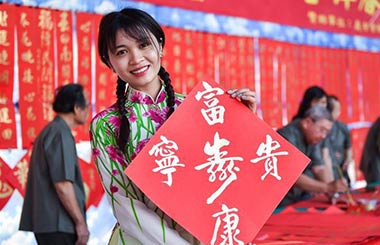
Wing Young Huie says he has been surprised that he and his camera are so often pulled to urban areas that have been stigmatized. This image is titled Miss Congeniality. Photos Provided to China Daily |
 |
|
Huie has published five books of his works and has been lecturing at several Chinese universities in the past year. |
 |
|
In his photograph Fireworks, Huie subtly uses composition to suggest a subject's emotion. |
A Chinese-American photographer chases identity issues from coast to coast, trying to find himself, as he tells Darnell Gardner Jr.
Related: Lomography: a mix of vintage and chic
Chinese-American Wing Young Huie, exploring what it means to be American, has used his camera to document US life for 35 years. He's pursued his craft in hopes that he can engage US audiences in a discussion about the complexities of their national identity. Now, he's sharing his insights with a Chinese audience.
Identity and the American Landscape is a selection of 60 images taken by Huie on a trip across the United States. The exhibit has been touring China since 2010 and is expected to make its final stop in Jiangxi province in November.
Huie says he was excited to be able to bring the exhibit to China.
"I think for any child of immigrants, it's a big thing to go to back to the motherland," he says. "It's always the dream of children of immigrants to move back to their parents' homeland."
Though Huie had traveled to Hong Kong in the past, his first trip to the Chinese mainland was at the exhibition's opening in Beijing about two years ago.
Much of Huie's work is driven by what he describes as his "hyphenated identity". He was born to Chinese immigrants from Guangdong province, and of his parents' six children, he was the only one born within the United States.
This background didn't just differentiate him from other Americans, it drew a line between him and the rest of his family. He remembers having trouble relating to his parents while he was growing up, especially with his mother, who spoke very little English.
"There were few people in popular culture that reflected my parents' identities," he says. "There were times when my own parents seemed foreign and exotic to me."
Huie often felt just as out of place outside his home.
"Growing up, we were the only Asian family in the neighborhood," he says. "When another Asian kid showed up in school, I avoided him. I don't think I realized I was avoiding someone that looked like me."
In an attempt to better understand his own identity and to create a counter to what he perceives as superficial portrayals of American society in the media, Huie embarked on trip throughout the US that sometimes brought him to unexpected places.
"A lot of my projects were of urban areas, which are very stigmatized," he says.
Huie realized his own perceptions weren't immune from media biases at the project's outset.
"When I was first trying to photograph these people, I was frightened," he says. "But once I got started and became familiar with the neighborhoods, I could approach anyone."
After he'd completed his cross-country trip and was beginning work on organizing the exhibition, Huie says he remembered the other Asian kid he'd avoided in high school.
"I started thinking about that kid in high school and why I'd avoid someone like me," he says. "I realized you are what you see, and as I looked around me, I didn't see anyone that looked like me. I forgot what I looked like."
But while Huie has been able to crack open the shell of the American experience, he thinks many outsiders are never exposed to the realities of life in the US.
"A lot of people are shocked at my photographs," he says. "Their idea of America is Hollywood, but I'm showing them everything, like life in inner-city neighborhoods."
Huie conducted lectures at several of the exhibit's stops in China, including Beijing's Tsinghua University. He recalled one student struggling to reconcile what he saw in Huie's images with what he'd learned about the US through popular culture.
"One person stood up and said, 'But you are showing us images of what America is really like, not the rich paradise we know it is,'" Huie says.
Reconciling such images isn't always easy, as Huie knows firsthand. He says part of his goal in bringing the exhibit to China is to challenge people's assumptions about American society.
"In America, we live in a white culture," he says. "The idea in my photographs is to show the reality. I'm just trying to understand who we are."
Huie has published five books of his work, including Looking For Asian American: An Ethnocentric Tour, Lake Street USA, and Frogtown: Photographs and Conversations in an Urban Neighborhood.
Contact the writer at sundayed@chinadaily.com.cn.
|
|
|
|
|
|
|
|

Copyright 1995 - . All rights reserved. The content (including but not limited to text, photo, multimedia information, etc) published in this site belongs to China Daily Information Co (CDIC). Without written authorization from CDIC, such content shall not be republished or used in any form. Note: Browsers with 1024*768 or higher resolution are suggested for this site.
License for publishing multimedia online 0108263 Registration Number: 130349 











 Raymond Zhou:
 Pauline D Loh:
 Hot Pot
 Eco China
 China Dream
 China Face