|
|
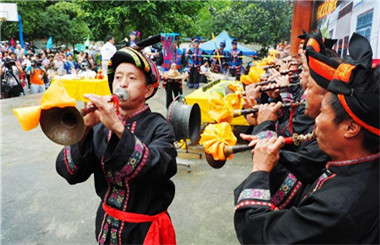
US first lady Michelle Obama presents an International Spotlight Award to a Chinese group in the White House for preserving the cultural heritage of the Dong ethnic group on Nov 19. To her left is Wu Lianyun, Ren Hexin and Deng Hongbo, deputy chief of mission and minister of the Chinese embassy in the US. Zhang Jun / Xinhua |
No written music
Wu Lianyun had been living with her parents, who for years worked at factories in the southern coastal province of Guangdong. Before returning to study in Dimen last year, the Internet-savvy teen couldn't sing any ethnic songs.
Even children who grow up in Dimen usually speak Mandarin at school and get little exposure to their indigenous culture or language other than from grandparents.
Without any written music, Dong songs are literally kept in the memories of the older generation.
Statistics from the Intangible Heritage Protection Center of Guizhou province show that the 244 "singing masters of Dong songs" recognized by the central and provincial governments have an average age of 68. The oldest master is 92.
"The population of Dong singers is so small. If, gradually, people are all singing popular songs, in two to three generations, the Dong songs will probably disappear," says Lee, who visits Dimen every year with her husband, Ken Smith, an art critic for Britain's Financial Times.
Tension between tradition and modernity prompted Ren and the workshop to draft a proposal on preserving Dong culture for the Liping county government right after Lee's 2002 trip.
"It is inhumane to force the Dong people back to follow their ancestors' way of living, but we can't just do nothing but watch the songs die, as they carry the history and wisdom of the ethnic group," Ren says.
The broader initiative, Passing Down Dong Culture, was established in 2003 when the workshop was tasked to advise the county government and Ren was named the group's executive director.
The first step was 100 Dong Songs.
In 2003, Ren selected 30 Dong teenagers who had recently graduated from ninth grade, from Dimen and neighboring villages, to begin intensive vocal training.
With guidance from the "singing masters", they shared the folk music in their villages and traveled to learn the songs' context.
Song sessions
At a common age for Dong people to leave school, five students quit the program to seek work outside their mountainous home region, while the 25 who remain have been the backbone of the Saturday morning song sessions since 2005.
"It is like an experiment," Ren says of the weekend training. "Now, we try to make the after-school activity a new conduit for Dong songs. But if it doesn't work out well, we will seek new ways to preserve the culture."
In recent years, the village has embraced "high-end" guests thanks to the efforts of Lee and her husband.
Apart from Tan, National Geographic photographer Johnson Lynn and composer Stewart Wallace have sought inspiration in Dimen.
In 2007, Nobel-laureate economist Joseph Stiglitz and his wife set foot in the village at the invitation of Lee and Smith.
Despite growing attention and numerous awards, Ren is clear-eyed about the prospects for Dong culture. He heard that Wu told reporters she wasn't that interested in singing Dong songs. "It is understandable and pretty common among kids in Dimen," Ren says.
"But to ensure the future existence of their own culture, we have to keep them exposed to the songs and try to make it more interesting."
Dong songs require multiple-part vocalizing, so students must practice and perform in a group and take different parts within it. Wu can sing about 10 Dong songs.
According to Ren, it wasn't so much vocal skill as a willingness to reach out and share the craft that made Wu the chosen representative of her fellow students.
Since she joined the workshop program a year ago, she has brought about 15 peers from her village every Saturday to take the singing course. Other students have been organized in the same way by "little leaders", such as Wu.
"Kids tend to go with the flow," Ren says.
"If their friends sing in the museum, they will also follow suit."
Contact the writers through charlenecai@chinadailyusa.com.

|
|
|
|
|
|
|
|

Copyright 1995 - . All rights reserved. The content (including but not limited to text, photo, multimedia information, etc) published in this site belongs to China Daily Information Co (CDIC). Without written authorization from CDIC, such content shall not be republished or used in any form. Note: Browsers with 1024*768 or higher resolution are suggested for this site.
License for publishing multimedia online 0108263 Registration Number: 130349 



















 Raymond Zhou:
 Pauline D Loh:
 Hot Pot
 Eco China
 China Dream
 China Face