|
|
|
||||||
 |
|
|

|
|||||
 |
||
|
|
|
|
|
|
|
||
|
|
|
|
|
| Advertisement | |||||||||||||||||||||||||||||||||||||||||||||
|
Feature: From A-bomb to Shenzhou-5 ( 2003-10-17 15:34) (Xinhua)
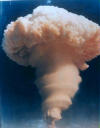
On the same day 39 years ago, the country exploded its first atom bomb, shocking the rest of the world. It was followed by the successful explosion of an H-bomb three years later. Then the first satellite that sang the tune of "Dong Fang Hong" (The East Is Red) declared to the world that China had mastered the artificial satellite technology.
The achievements have testified to the correctness of the policy decisions the first generation of Chinese leadership headed by Mao Zedong took after sizing up the then international situation following the A-bomb dropped by the United States in Hiroshima, Japan.
As the Chinese people were still immersing in the success of the A-bomb, H-bomb and the satellite, a space dream was in the making. But the dream did not come true until the 1980s due to limited economic strength. The manned space flight program was not put on the agenda until March 1986, when China listed the manned space flight program in the hi-tech development program 863 against the background that the United States was engaging in a star war, Europe launched the "Eureka" program and the former Soviet Union launched the accelerated development strategy.
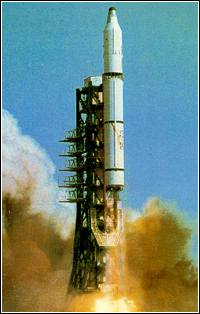
From the launch of the first rocket, the country has developed 12 types of rockets, which have sent 70 Chinese and foreign satellites into the low earth orbit, the geostationary orbit and the sun-synchronous orbit. The space exploration project started toward the turn of the century. The country launched four unmanned Shenzhou spaceships before proceeding with the manned space flight. Without the atomic and hydrogen tombs and the first satellite, there would not have been commercial satellite launch service, nuclear power plants, satellite-based communications and remote sensing or computer and microelectronics industries, said an expert who is directing China's manned space flight project.
Among the first generation of Chinese space scientists and technicians, many returned from abroad. They included renowned physicists Qian Xuesen, Zhao Zhongyao and Peng Huanwu. When asking about the reasons why they returned, Peng Huanwu, the first Chinese physicist who had obtained the professorship in the UK, said "There is no need of stating reasons for the return. what needs stating reasons is not to return." The R&D of space equipment has brought up a full generation of young scientists. They include the 27-year-old rocket trouble detecting system commander Liu Feng, the 29-year-old cosmonaut trainer Chen Xin, the 32-year-old spaceship environmental control and life insurance system commander Liu Xiulian and the 37-year- old spaceship system deputy chief designer Qing Wenbo. Among the space program contingent, more than 70 percent are young people below 35. Among the designers and commanders of the manned spaceship, more than 80 percent are young people under 40. "There is a full force of successors to China's space program," said Wang Yongzhi, 70-year-old academician of Chinese Academy of Engineering.
|
|
 |
|||||||||||||||||||||||||||||||||||||||||||
| .contact us |.about us | |||||||||||||||||||||||||||||||||||||||||||||
|
|
|
|
|
|
|
|
| Copyright By chinadaily.com.cn. All rights reserved |