|
English>News Center>lifestyle | |
|
|
|
|
|
|
|
|
|
|
||||||||||||||||||||||||||||||||||||||||||||||||
|
|
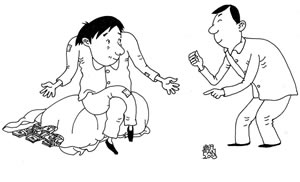
Rich Hatred Unlike Westerners, who typically feel proud of their prosperity and like to show it off, well-to-do Chinese appear to want to hide their wealth. It was reported that when the Forbes "Rich-List" was first published in China in 1999, it received an especially cold shoulder from the Chinese.
A fear of robbery was no doubt an important reason for this attitude but who knows whether the list would have been a useful guide for robbers? Although robbery exists everywhere in the world, it would be hard to find another country where so much tolerance towards robbing the rich exists among the ordinary people as it does in China. "Rarely is there any country which has expended as much ink as China has on depicting and praising people who rob the rich to feed the poor," said one article published on the website of Chinese Academy of Social Sciences. Some history books have canonized people who have ravaged the rich and shared the treasure with the poor. They have been painted as heroes, regardless of the cruelty sometimes involved in their "knightly" acts. Such stories are often seen in various kungfu movies and stories. To some degree, people have become imbued with a feeling that the rich are vicious people. When this is combined with the long-held Chinese belief in "evenness", it may make the low profile sought by Chinese businessmen much easier to understand. Rich hatred An ancient saying has it that: "There is no worry about having less but there is about unevenness". "Sharing alike" has long been accepted as the rule for fairness in China and the "unevenness" of possessions between rich and poor was regarded as being grossly unfair. When the numbers of those treated "unfairly " reached a certain level, periods of struggle and rebellion occurred with the leaders of revolt raising the flag of "jun pin fu" - to achieve equality between rich and poor - as their goal. Such a war cry would always help them win strong support from the common people. Uprisings like this occurred in every dynasty of China's 5,000-year history. Yet unfortunately, the ideal of "jun pin fu" always remained a dream and was never really achieved. All the uprisings only gained half their goal - to rob the rich. Many of the rebel leaders were too busy sharing out the loot among themselves before even thinking about feeding the poor when the struggle was supposed to be all about relieving the oppressed. "But the ideology of 'jun pin fu' and hatred towards the rich has, to some degree, remained with the Chinese, influencing their philosophy about wealth," said Jiang Tiezhu, a professor from the Shanghai Social Sciences Academy. Humble business people Longing for wealth is part of human nature, but in China such a longing was repressed for a long time. Apart from "evenness" ideology, the Confucian doctrine of extolling the gaining of knowledge and the acquisition of virtue has also prevented people from focusing too much attention on greed for material possessions. Those who were materially rich but spiritually poor were regarded as immoral and base, and the poor who were rich in knowledge, with noble minds were regarded as gentleman or even as sages. Unfortunately, wealthy people - especially those who had made their money through business - were looked down upon. One ancient saying goes: "All businessmen are profiteers" and surely profiteers cannot be rated as gentlemen. Another Confucian saying goes: "A gentleman should stick to his poor life." Apart from Confucian cultural influences, the administrative authorities also put pressure on business people. Agriculture always occupied a much higher social position than business in ancient society. The development of agriculture could bring stability to society while business only brought uncertainty. Piecing these two together led to a philosophy about wealth among learned people in ancient China - "an pin le dao", meaning to feel at ease with the poor life while taking delight in pursuing virtue and knowledge. Influenced by such a philosophy, rarely did any learned people make wealth their first goal, or at least they would carefully conceal their yearning for material things when in front of others. The story of Huizhou in Anhui Province, is one example of this conflict. Huizhou was famous in ancient times for the large number of businessmen there. Evidence of the great fortunes they made can still be seen in the magnificent buildings there today. Yet, interestingly, all the businessmen of Huizhou sent their children to study instead of running the family businesses. They wanted their children to be scholars and to enter the ranks of imperial officialdom rather than become businessmen. It was only about a decade ago that the restraint on people's pursuit of wealth was relaxed in China. People are now encouraged to try to live better and the government is urging the population to quit their old attitude of "an pin le dao" and to take up a new philosophy of "becoming rich through hard work". The country is even thinking of changing some lines of the Constitution to give protection to private business. "Times are changing and so is people's philosophy of wealth," Jiang said. "Maybe in another few years, when a Chinese is asked what it is inside his bulging pocket, he will proudly say it is Renminbi even if it is just tissue paper."
|
|
||||||||||||||||||||||||||||||||||||||||||||||||