|
Home>News Center>Life | |
|
|
|
|
|
|
|
|
|
|
|||||||||||||||||||||||||||||||||||||||||||||||||||||||||||||||||||||||||||||||||||||||||||||||||||||||||||||
|
|
NASA: Liquid water once on Mars
NASA scientists say the Mars rovers have found what they were looking for -- hard evidence that the red planet was once "soaking wet."
"We have concluded the rocks here were once soaked in liquid water," said Steve Squyres of Cornell University, the principal investigator for the science instruments on Opportunity and its twin rover, Spirit. "The second question we've tried to answer: Were these rocks altered by liquid water? We believe definitively, yes," Squyres said. Squyres and other NASA officials made the announcement at NASA headquarters in Washington after several days of dropping tantalizing hints that something significant had been discovered.
Scientists used instruments on board the golf cart-sized rovers to study the composition of the rocks and soil on the planet. The rocks' physical appearance, plus the detection of sulfates, make the case for a watery history, and, more importantly, an environment that could have been hospitable to life. While reporters pushed the scientists to come up with a "when" for the existence of water on Mars, Squyres said it was very difficult to infer an age simply by looking at pictures. He said a physical examination of samples would be the only way to get close to a time frame. Squyres offered a couple of scenarios on what might have happened that led to the current discoveries: One is that there was a volcanic eruption -- possibly many eruptions -- and that volcanic ash settled on the Martian surface. Subsequently, water could have percolated through the ground, altering the ash to the chemical composition it has today. Another possibility, said Squyres, is that there was a salty sea at the Meridiani Planum location, perhaps with currents -- possibly even waves. As the water evaporated, the salt would settle out. "Both are fundamentally possible," said Squyres. "But we may never know."
But geologists and other researchers at NASA's Jet Propulsion Laboratory in Pasadena, California, were thrilled when they saw the possibilities surrounding Opportunity, which landed three weeks later. It landed inside a small crater in the Meridiani Planum, one of the flattest surfaces on the planet. And its landing site was within driving distance for the spacecraft to reach an exposed slice of bedrock. Since its landing January 25, Opportunity has used the same tools as a field geologist to determine the chemical contents of the rocks. Using an alpha particle X-ray spectrometer, a device that can identify chemical elements, scientists have identified a high concentration of sulfur in the bedrock.
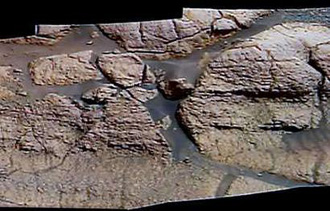
The Mars rover Opportunity examines "El Capitan." Another instrument on board, a Moessbauer spectrometer, has detected an iron sulfate mineral known as jarosite. From their knowledge of rocks on earth, scientists say rocks with as much salt as this Mars rock either formed in water, or had a long exposure to water after they were formed. The scientists say these rocks could have formed in an acidic lake or even hot springs. Scientists say the case for a watery past is further strengthened by the pictures taken by the rovers' panoramic cameras and its microscopic imager. One target rock named "El Capitan" is filled with random pockmarks. Geologists say a texture like that comes from sites where salt crystals have formed in rocks that have sat in salt water. Scientists say they have gained other clues from the physical appearance of the rocks. They see a pattern called "crossbedding," which is often the result of wind or water moving across the rock's surface. So what is ahead for the final few weeks of the rovers' operations on Mars? "We need to take a close look at the outcropping, and broaden our view to get a better understanding of the geology of the region, which is about the size of Oklahoma," said Joy Crisp, project scientist at the Jet Propulsion Lab. She said there are also plans to drive about 740 meters east to a crater that has been nicknamed "Endurance." And in the longer term? "It's clear we have to do a sample return, both for the scientific side and in preparation for human landing," said Weiler. He said future Mars missions would also include miniaturizing equipment and landing equipment that would help prepare for the eventual landings of humans. That might include tests for toxicity in the soil and determining if there are any materials that humans might find useful when they arrive. The cost of the two rover missions is about $820 million. With solar panels and lithium-ion battery systems aboard, each rover is expected to function and communicate with Earth for about 90 Mars days, known as "sols." That's the equivalent of 92 earth days. |
|
|
|
|
||||||||||||||||||||||||||||||||||||||||||||||||||||||||||||||||||||||||||||||||||||||||||||||||||||||||||
|
|
|
|
|||||||||||||||||||||||||||||||||||||||||||||||||||||||||||||||||||||||||||||||||||||||||||||||||||||||||||||