|
Home>News Center | |
|
|
|
|
|
|
|
|
|
|
|||||||||||||||||||||||||||||||||||||||||||||||||
|
|
NASA notes most distant object in solar system
Scientists on Monday announced the discovery of a frozen, shiny red world some 8 billion miles from Earth that is the most distant known object in the solar system. They are calling it a "planetoid," saying it does not meet the definition of a planet.
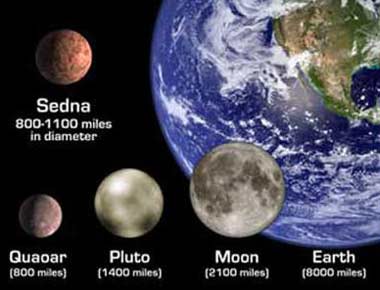
"There's absolutely nothing like it known in the solar system," said Mike Brown, the California Institute of Technology astronomer who led the NASA-funded team that found it last year. Named Sedna, after the Inuit goddess who created the sea creatures of the Arctic, the planetoid is 800 to 1,100 miles in diameter, or about three-quarters the size of Pluto, and probably half rock, half ice. It is currently three times farther from Earth than Pluto, the ninth and outermost planet. Sedna is the largest object found orbiting the sun since the discovery of Pluto in 1930. It trumps in size another icy world, called Quaoar, discovered by the same team in 2002. Sedna follows a highly elliptical path around the sun, a circuit that takes 10,500 years to complete. It loops out as far as 84 billion miles from the sun. From Sedna's surface, the sun would appear so small that it could be blocked out by the head of a pin. It is well beyond the Kuiper Belt, a region of ice and rock just beyond the orbit of Neptune. Brown and his colleagues believe Sedna is the first known member of the long-hypothesized Oort Cloud, a sphere of material orbiting the sun that explains certain comets. If Sedna is part of the Oort Cloud, the cloud extends much closer inward toward the sun than previously believed.
The Oort theory holds that comets in the cloud probably started out as icy objects in places like the Kuiper Belt that were flung out of the solar system by one of the giant planets. The location of Sedna suggests that it got stuck where it is because its orbit was affected long ago by a star that is no longer nearby. "What we think must have happened is that early in the history of the solar system, there must have been many, more stars very close to the sun than there are now," Brown said. The sun, in other words, was born in a tight cluster of many stars. Sedna is one of the most pristine objects in the solar system. "Very little has happened to this object since the beginning of the solar system," Brown said. "There's not much else out there, so it hasn't been impacted by other objects, it hasn't been heated by the sun. It really has just been sitting out there at 400 degrees below zero for the past 4.5 billion years." Brown would not classify Sedna as a planet, based on a definition of a planet as an object considerably more massive than any other object in a similar location. "Sedna sits all by itself in the very outer reaches of the solar system, but our prediction is there will be many, many more of these objects found over the next five years or over the next decade, and it will turn out that Sedna, in fact, is not the most massive object in its orbit out there," Brown said. Brown, Chad Trujillo of the Gemini Observatory in Hawaii, and David Rabinowitz of Yale University discovered Sedna last November, using a 48-inch telescope at Caltech's Palomar Observatory east of San Diego.
Within days, other astronomers around the world trained their telescopes, including the recently launched Spitzer Space Telescope, on the object. "It took us a few weeks of continuing to see this object until we were really convinced we had stumbled on something big," Brown said. The team also have indirect evidence a tiny moon may trail Sedna, which is redder than all other known solar system bodies except Mars. |
|
|
|
|
||||||||||||||||||||||||||||||||||||||||||||||
|
|
|
|
|||||||||||||||||||||||||||||||||||||||||||||||||