|
Home>News Center>Life | |
|
|
|
|
|
|
|
|
|
|
|||||||||||||||||||||||||||||||||||||||||||||||||
|
|
Exhibition highlights Hong Kong's history
For people who have never been there, Hong Kong conjures up images of its skyscraper skyline, its plethora of pop stars and Christmas shopping queues.
But they are likely to change their less than positive views if they visit the ongoing Hong Kong exhibition at the National Museum of China to the east of the Tian'anmen Square. Titled "Bits of Old Hong Kong," the exhibition, which runs until July 29, offers an overview of the history and local development of the special administrative region. It is co-sponsored by the national museum, the Hong Kong Museum of History and the Hong Kong Special Administrative Region's government. It features 150 cultural relics and 128 photos from the collection of the Hong Kong Museum of History. "We want visitors to take a trip back up the river of time," said Joseph Ting, who is the co-curator of the exhibition, along with Wang Nan, a researcher with the National Museum of China. "Walking in the exhibition hall they will feel like they are rambling along the streets and alleys of Hong Kong in old times, seeing how people of yesterday lived, how they, in their unique way, blended aspects of Western culture with Chinese traditions," he added. Ting, director of the Hong Kong Museum of History, has been doing research on Hong Kong in the 18th, 19th and 20th centuries since 1979, when he started working at the museum. The exhibition is divided into three parts to illustrate the development of Hong Kong's unique culture. The first tells the story of Hong Kong in the 19th and 20th centuries, the second focuses on its urbanization process and the development of various industries, and the third examines the reasons why Chinese traditions have been retained. The exhibition can be intriguing even to those who have little interest in learning about history.
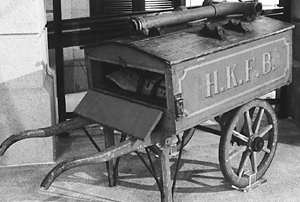
A fire "engine" on display, which is 4 metres long and 2 metres high, has no engine and was pushed around by men. It was used in Hong Kong at the beginning of the 20th century. A land lease contract signed in 1905, a house purchase contract signed in 1911, a telephone used in 1926, a record player popular in the 1930s, and a camera used at a photo studio in the 1940s all help give visitors a tangible taste of the region's past. There is also an example of a type of two-wheel vehicle drawn by a man that was often seen in Hong Kong streets in the 1950s. Amazing are a collection of calendars, which were printed between the 1920s and 1940s in Hong Kong. Large department stores and companies of the time had these calendars designed and printed, to carry their advertisements. The calendars, featuring mostly portraits of beauties painted by popular artists, are delicate and interesting, as they show how people's aesthetic criteria varied over the decades. The exhibits also include about 10 kinds of currencies that were circulated in Hong Kong after the First Opium War (1840-42). "We can see at the exhibition that Chinese traditions have been retained in metropolitan Hong Kong, especially in the New Territories, where schools teaching Confucianism were established as far back as the Song Dynasty (960-1279)," said Liu Shuyong, a researcher with the Institute of Modern Chinese History of the Chinese Academy of Social Sciences. "Certain traditional customs have been better preserved in Hong Kong than in many areas of the Chinese mainland, such as the celebration of the Dragon Boat Festival, the Mid-autumn Festival, and the offering of sacrifices to ancestors at the beginning of each spring and autumn," he added. Liu said that contrary to widely held views, Hong Kong actually has a long history of civilization that can be dated back to the Neolithic Age. Bronze and stone artifacts unearthed in the area share design and decoration features similar to those on artifacts found in neighbouring Guangdong Province. By the 19th century, Hong Kong, no longer "an island of rocks" or "a small fishing village," as the British described it in many books, had grown into a prosperous area governed by administrators appointed by the court of the Qing Dynasty (1644-1911) and defended by the Qing imperial army. The area had a population of 7,450 according to imperial records during the Qing Dynasty, and local residents built numerous villages and enjoyed the same level of economic, cultural and educational development as did those in neighbouring Guangdong Province, Liu noted. The population grew rapidly after 1841 when British warships seized Hong Kong Island. It had reached 1.6 million on the eve of World War II (1939-45) as a result of several major tides of migration, said Ting. The migrants, mostly from the mainland, but with some from Europe, the Americas and other parts of Asia, contributed to the formation of a unique culture in the melting pot of Hong Kong. The culture, in return, had an impact on the ideological tides in the mainland in the 19th and 20th centuries, Ting said. Scholars who developed their ideas in Hong Kong include Hong Rengan (1822-64), who attempted to adopt the management methods of capitalistic society during the brief emergence of the Taiping Heavenly Kingdom (1851-64); Wang Tao (1828-97), who promoted the establishment of constitutional monarchy and the development of modern industries in China; and Hu Qi (1859-1914) and He Liyuan (1847-1916), whose literature on social reforms greatly inspired later reformists like Kang Youwei (1858-1927) and revolutionists like Sun Yat-sen (1866-1925). Ting believes the exhibition will help make visitors aware of the impact of the tides of immigration on the formation of Hong Kong's culture and the culture's importance in the development of modern China. Three video documentaries on Hong Kong's history are also being shown at the exhibition. |
|
|
|
|
||||||||||||||||||||||||||||||||||||||||||||||
|
|
|
|
|||||||||||||||||||||||||||||||||||||||||||||||||