|
Home>News Center>China | |
|
|
|
|
|
|
|
|
|
|
||||||||||||||||||||||||||||||||||||||||||||||||
|
|
Sex slave sights subject of debate
Guan Bo, a resident of Guangzhou, capital city of South China's Guangdong Province, still remembers exactly the place where many women were forced to serve as sex slaves, or so-called "comfort women," for Japanese soldiers during the 1930s. "It was on Donghuadong Road, and it was in late October 1938 that I began to see lots of women, mostly Korean, going out to shop when there were no Japanese soldiers in the house," Guan said. Guan, now 83, opened a grocery store on Donghuadong Road when he was only 18.
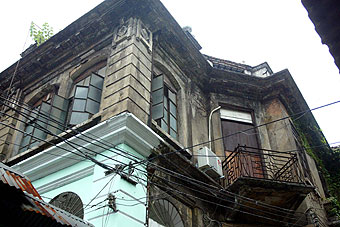
"The Japanese soldiers used the houses for the women they forced into sex slavery," said Guan. There is an old five-storey house at 11 Dongyuan Street off Donghuadong Road that used to be a brothel full of Korean and Chinese comfort women for Japanese soldiers. According to historians, hundreds of thousands of women were forced to become comfort women for Japanese soldiers in the 1930s and 1940s when Japan launched its war of aggression against other Asian countries. The Japanese invaders occupied Guangzhou from 1938 to 1945. Guangzhou-based Information Times earlier reported that there are altogether nine addresses in Guangzhou where hundreds of women were forced to serve as sex slaves for the Japanese invaders during World War II. The report said the nine locations are on Xihang Road, Wushan Road, Zengbu Road, Tongfuxi Road, Donghuadong Road, Guangxiao Road, Haizhunan Road, Gangding Road and Dengzhengnan Road. A number of these places have already either been destroyed or removed, such as the house on Haizhunan Road, while others have been refurbished as private dwellings, shops, schools or hospitals, according to the newspaper. For example, the house on Gangding Road was rebuilt as a school in the 1970s and the one on Donghuadong Road was turned into an apartment building after the war. Protect or destroy? The reports about the possible demolition of these historical places where comfort women once suffered have aroused hot arguments among citizens and scholars in the city. The arguments focus on whether or not the local government should protect these nine historical sites, or have them listed as protected sites of historical significance. With the exception of the old residents who lived in these areas during World War II, few local residents knew anything about these places and the evil use to which they were put. So many of the local residents who are familiar with the past called on the government to protect the nine places, since they are part the historical evidence of the crimes the Japanese military committed in Guangzhou during World War II. In addition, they said that protecting the nine places will help ensure that the younger generations do not forget this dark chapter in the nation's history. "The long period when the city was occupied and thousands of our compatriots were used as sex slaves must never be forgotten," said Huang Bo, 79, a Guangzhou resident. Li Xianheng, a local historian, says. "I think it is quite necessary to put these nine places on the list of protected historical sites in the city, because they are reminders of the evil aggression of the Japanese invaders," said Li. About 10 years ago, the Guangzhou municipal government launched an inspection campaign of historical sites and only found the place on Donghuadong Road where women were forced to be sex slaves for Japanese soldiers, according to Li. Li said that the place was not at that time put on the list of protected historical sites. "It would take a long period of time to bring forward proposals and take effective measures to protect the site at the time," he added. In addition, the city planned to destroy the place at that time, in an effort to expand its urban development, according to Li. "But since we have now found not one but nine such places, we should take effective measures to protect the nine sites so they can be used to educate coming generations," said Li. Despite local residents' appeals for the preservation of the nine places, officials of the local government said only when the exact locations of the places once full of comfort women during the war were found should the protective measures be taken. "At present, it is hard for the government to take effective measures to protect the places, since further investigation is needed," said Lin Yajie, vice-secretary of the Guangdong Provincial Political and Consultative Committee. In addition, Lin even argued that protect the nine sites would have no historical value. "Protecting the places where sex slaves for Japanese soldiers were kept, will not necessarily be effective in educating future generations," said Lin. According to Lin, there should be some clear criteria established upon which to base decisions as to whether or not historical sites should be protected. |
|
|
|
|
|||||||||||||||||||||||||||||||||||||||||||||
|
|
|
|
||||||||||||||||||||||||||||||||||||||||||||||||