From the days when couples pledged their troth before a picture of Chairman
Mao and read from his "Little Red Book," weddings in China have changed beyond
the wild imaginings of people more than 20 years ago.
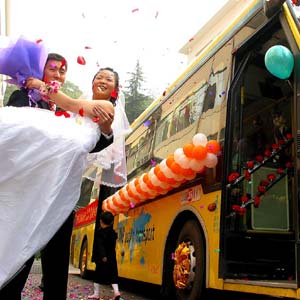
A bridegroom is
ready to carry his bride into a rented public bus in Nanjing, Jiangsu
Province, to start their wedding celebration. [File
photo] |
Today it is a multi-million dollar industry, filled with spectacle and
panache. But one which rarely fails to combine the tradition of the style and
elegance of old China with arguably the best of the West.
Among those who have turned matrimony into a money-making art is Chen Tao.
Ten years on he still recalls the thrill of the first "modern"wedding
ceremony he attended in Shanghai. As a technical school student from a poor
inland province, Chen had never seen such a grand party and he was amazed.
"It was a wonderful experience, and the wedding dress was terrifically
beautiful!"
When Chen himself married a year after his Shanghai experience, he bought a
fashionable wedding gown from Shanghai for his bride. They were the first couple
to wear such clothes at their formal wedding ceremony in Yibin, a city in
Southwest China's Sichuan Province.
"It made quite a stir in the city!" Chen recalls. Shortly after the ceremony,
a lot of people approached the newly-weds wanting to borrow the dress. That gave
them the idea to set up their own wedding agency .
In the first year their fledgling company helped organize more than 100
weddings. And today it averages 600 a year. With more than 30 employees, the
company has, to date, arranged weddings for more than 6,000 couples.
"Business is brisk, and we have no rivals in Yibin yet," says Chen.
Since 1990 when China's first wedding agency was set up, the industry has
developed in leaps and bounds. The knock-on effect has been to boost the growth
of a dozen other industries such as hairdressing, jewellery and gifts, furniture
and home appliances, hotels and tourism. Official statistics show that
approximately 10 million couples register to marry annually in China and spend
some 250 billion yuan (US$30 billion) on their weddings. The figures are
expected to grow on both fronts.
Zhang Guoliang, an industry veteran, attributes the rapid development of the
industry to China's reform and opening-up drive initiated by the late leader
Deng Xiaoping two decades ago. This has not only improved living standards, but
also liberalized the ideas of many ordinary Chinese.
"Over the last two decades, the industry has recorded numerous changes of
both the style and content of wedding ceremonies," said Zhang.
Wedding ceremonies organized by Chen Tao's company generally fall into three
categories: Chinese-style, Western-style and a Chinese-Western combination. Of
the three, the most popular is the Chinese-Western combination, which accounts
for about 80 per cent of all weddings. A typical combination-style ceremony, in
Chen's view will have the bride, dressed in white, escorted by her father along
a red carpet to the waiting bridegroom where rings are exchanged in front of
family and friends. This is followed by a wedding banquet at which the bride
switches to wearing a traditional red cheong-sam, a gown with side slits, and
her husband at her side toasts the guests.
"At a Chinese-style wedding ceremony, the couple would pay their respects to
the heavens and earth and exchange toasts," Chen explains. "This is an important
part of traditional Chinese wedding culture."
Zeng Zhihua, a professor with the Communication University of China, agrees,
adding: "Industry practitioners should pay great attention to a combination of
tradition and reality, as well as relationships between Chinese and Western
cultures."
Zhang Guoliang says he understands young people's preference for novel
wedding styles. "I've done my utmost to meet their demand," he says. In the
years he has been arranging weddings, Zhang has done his best to accommodate
even the out-of-the ordinary. Some off-beat ceremonies were conducted on
grasslands and some were under water. "I'm planning to organize a bungee jumping
wedding ceremony in the near future," he says.
Inferior services
With the rapid development of the industry, the number of complaints over
wedding products and services has increased. In 2002, the Shanghai Consumers
Association handled 49 complaints accusing practitioners of providing inferior
services and products. Last year, complaints handled by the association had more
than doubled to 120, up 131 per cent on the previous year.
Experts point out that China's wedding celebration industry has remained at a
relatively low operating level. To date, there are no widely recognized brand
products and most companies offer similar products and services, depending on
their respective interpretation of what comprises a wedding celebration, as
there are no generally accepted standards.
In the first half of 2004, the China Women and Children Development Centre
organized a national wedding Master of Ceremonies contest, the first of its kind
in the country, in an attempt to help improve their professional skills and
overall quality.
More than 2,000 professional and amateur MCs took part in competitions in 20
cities before the final contest took place in Beijing on June 28.
The contest has achieved its intended purposes, according to Lu Yanping, an
official with the centre. It has not only provided an arena for industry
practitioners to co-operate and learn from each other, but also resulted in the
establishment of a China Wedding MC Club, a national organization that will lay
down a set of industry standards, organize contests and provide training, said
Lu.
Even industry veteran Zhang Guoliang marvels at the changes in just one
aspect of Chinese life in more than two decades. During the "cultural
revolution" (1966-76), a typical wedding ceremony consisted of the bride and
groom standing in front of a portrait of Chairman Mao and reading from Mao's
Little Red Book, a digest of quotations from Mao's works.
"Things are different now," Zhang says. "Instead of political oaths,
happiness is now the most important element of a wedding ceremony."