|
Home>News Center>China | |
|
|
|
|
|
|
|
|
|
|
||||||||||||||||||||||||||||||||||||||||||||||||
|
|
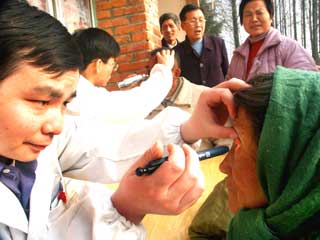
50% of farmers can't afford to see doctors
The number of pilot medical co-operatives in China's countryside is growing rapidly, but the central government is taking a cautious attitude. "We should have a clear mind that there are still some problems, such as poor public awareness, laggard rural medical capacity, and potential risks in the management of (co-operative) funds due to a lack of qualifications," said Zhu Qingsheng, vice-minister of health, during a press briefing on Friday.
Response has been strong, with the number of new co-operatives set to grow to at least 500 in 2005 from the current 310 scattered across 310 counties. "A more solid foundation will be laid for the full implementation of new programme by setting rules, developing supporting policies and improving management," Zhu said. Local governments have shown interest in the approach to funding medical care. However, the central government has decided to expand the programme gradually while improving financial management, rural healthcare systems, and strengthening the capacity building of executive agencies of co-operative funds. While the problem is not the lack of funds, difficulties arise in strengthening the capacity building of rural healthcare and treatment systems and fund management, which are vital for the smooth development of the co-operative service, but may take time to develop, said Zhu. Another big problem is the lack of investment in health from local governments in rural areas. In 2002, China's total health expenditures were 568.4 billion yuan (US$68 billion), some 5.5 per cent of its gross domestic products. However, the majority of this money is used in urban areas with only 30 per cent of the country's population, Zhu said. In 2003, the annual income of a farmer was 2,622 yuan (US$315) on the average. However, average in-patient hospital costs for that same farmer ran as high as 2,236 yuan(US$270). In China, especially in western parts, between 40 to 60 per cent of farmers do not have enough money to see doctors or be hospitalized. And among all the illness related deaths in western and central China, 60 to 80 per cent were in the home instead of in a hospital, Zhu said. One of the new measures to strengthen rural health coverage will be to better train the 1.2 million doctors in rural areas. Many of them are not competent. Better-trained doctors would further boost the comprehensive financial coverage provided by the co-operative model. The co-operatives are based on a mutual help system to cover treatment in the case of a serious illness. Generally, farmers willing to join pay a 10 yuan (US$1.2) premium per person per year. Those premiums are then pooled with 20 yuan (US$2.4) contributions from the central and local governments. Members can then have part of their medical expenses covered. Since July 2003, co-operatives have grown to cover 95.04 million farmers. Of them, 68.99 million or 72.6 per cent have joined the scheme. So far, a total of 3.021 billion yuan (US$364 million) in premiums has been collected. By the end of June, 41.94 million claims had been processed, and 1.394
billion yuan (US$168 million), or 46.14 per cent of the funds was disbursed.
|
|
|
|
|
|||||||||||||||||||||||||||||||||||||||||||||
|
|
|
|
||||||||||||||||||||||||||||||||||||||||||||||||