|
Home>News Center>China | |
|
|
|
|
|
|
|
|
|
|
|||||||||||||||||||||||||||||||||||||||||||||||||||||||||||||||||||||||||||||||||||||||||||||||||||
|
|
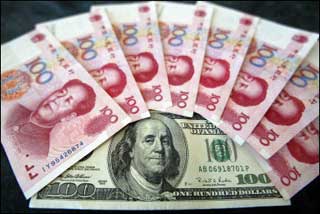
Speculative money: A hot potato for China
There are increasing signs that China has a window of opportunity to fine-tune its foreign exchange policies, especially given the nation's favourable trade and forex market, experts suggest.
"I will not forecast a quick action (on forex policy) by year's end, but there is a possibility China will adjust its forex policy within the next 12 months," Tao Dong, chief regional economist with Credit Suisse First Boston (CSFB), told China Business Weekly last week. "The timing is gradually becoming mature ... much better than earlier this year." China's current account is basically balanced, and exports continue to show strong momentum, Tao said. What's more, he added, the US dollar has been sliding to new lows against the euro and Japanese yen, which has given China more flexibility to relax control over its currency. The renminbi, China's currency, has been under great upward pressure in recent months. Many experts have suggested China needs a more flexible forex system, as it is integrating deeper into the global trade system. They have said, on the one hand, relaxing forex policies is a good answer to some foreign countries, which have long claimed China's fixed forex system gives the country an unfair trade advantage. On the other hand, they acknowledge a flexible forex system will benefit China, as a rigid forex system prevents the local currency from fluctuating with global market changes. A rigid forex system also restrains the government's flexibility in executing momentary policies. Keeping the local currency in a rigid system make it impossible to reflect the nation's rapid economic growth in the past two decades, experts said. A flexible exchange rate may also contribute to increased stability, by providing a safety valve to protect the real economy. However, China is unlikely to act quickly to relax its control over the foreign exchange system, given market uncertainties. Moreover, that would pose too big a risk to the nation's fragile banking and financial sector. Before China achieves success in its banking reform, the nation's banks might not be capable of taking the risks caused by policy changes in the foreign exchange system. Movements, if any, towards a more flexible foreign exchange system may have to be gradual. Hot money Speculation continues to mount that China may decide to revalue its currency in the near future. An estimated US$30-50 billion in "hot money," or speculative short-term foreign investments, may have entered China this year. Much of that would have been prompted by speculation that the currency will be revaluated. That huge sum of money has already affected, substantially, China's economy. "If capital inflows lead to an excess supply of foreign currency, the central bank must buy it and sell the renminbi to keep the exchange rate stable," Usha C. V. Haley, professor of management and international business at the US-based University of New Haven, told China Business Weekly last week. "This injects new liquidity into the banking system and feeds the credit boom, which contributes to the overheating of the country's economy. "The central bank has been issuing bonds to mop up the liquidity, but this sterilization is becoming more difficult as the amounts swell." The bank has had trouble selling enough bonds in recent months, and so the money supply has continued to surge, said Haley, who wrote "The Chinese Tao of Business: The Logic of Successful Business Strategy." Due to the surging inflow of hot money, the Chinese Government also faces a difficult task in raising interest rates, as such a move would entice more speculative investments, Gao Huiqing, a senior researcher with the State Information Centre, told China Business Weekly. Some short-term investments, after having entered China, have been parked in the property markets of Shanghai and Beijing, which has increased demand in the already overheated sector, he said. "The hot money has been a headache for China's monetary policy-makers, and that's part of the reason the government has had a hard time adjusting macroeconomic policies," Gao said. Experts suggest the huge inflow of speculative money has come from three main sources: International hedge funds; overseas Chinese's holdings; and Chinese companies which used to park their money abroad. Tao suggested many international hedge funds have not yet moved their money into China, as they are very sensitive about the costs of doing so. Hedge funds may hesitate to bet on China's undated renminbi appreciation, while losing opportunities to profit from other markets, Tao said. However, eyeing the high possibility for a stronger local currency, some Chinese companies and overseas Chinese, who are less sensitive to interest costs, may have transferred their overseas assets back home. The timing A revaluation of the renminbi seems inevitable, but the million-dollar question remains "when?" As a huge amount of hot money has been parked at the doorstep, the Chinese Government will not want to revalue the yuan at this point, analysts said. But additional delays could result in more difficulties. "It's a bit like diving from a high platform. Standing on the platform, you always feel it is too daring to jump down," Tao said. "But you may not notice the longer you stand, the harder it is to get up the courage to dive." Tao said the platform may already be too high for China to take any hasty action, but, on the other side, it is well understood that China's policy-makers have been trained to dive beautifully. And now, timing is really a work of art. People's Bank of China Governor Zhou Xiaochuan said it was the wrong time to talk about a specific technical arrangement during the G20 finance ministers and central bank governors meeting, held in Berlin a week ago. "Now, China is in the preparation stage," Zhou said. The Chinese Government has said it will move towards a more flexible exchange rate in the medium term, but, at present, it wants to keep the renminbi stable to support broader economic stability. "China may be reluctant to revalue its currency because it is waiting to gauge what a proper adjustment might be," Haley said. "The central bank may be concerned not just with short-term problems, but with the huge impact on the domestic currency value of its official reserves," Haley said. A small revaluation, of only 5 per cent, might also encourage expectations of a further appreciation, and attract more capital inflow and hot money. "But any revaluation would have to be fairly large, say 10-20 per cent, to head off more speculation. But a rise of such a magnitude would be unacceptable to the Chinese Government," Haley said. Gao said revaluation of the renminbi is becoming more of an issue of political concern than one of economic significance. Even if the timing is mature to adjust the forex policy, in terms of economic rationale, policy-makers must consider its political weights with a long-term vision, he added. |
|
|
|
|
||||||||||||||||||||||||||||||||||||||||||||||||||||||||||||||||||||||||||||||||||||||||||||||||
|
|
|
|
|||||||||||||||||||||||||||||||||||||||||||||||||||||||||||||||||||||||||||||||||||||||||||||||||||