|
Home>News Center>China | |
|
|
|
|
|
|
|
|
|
|
|||||||||||||||||||||||||||||||||||||||||||||||||||||
|
|
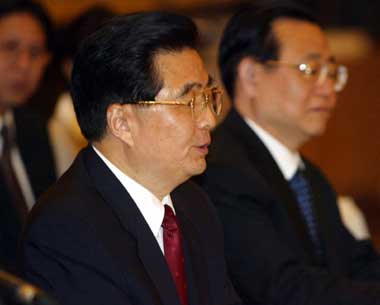
Leaders of China and Japan hold reconciliation talks
The leaders of China and Japan agreed to mend ruptured
ties during ice-breaking talks in Jakarta on Saturday, and Chinese President Hu
Jintao said Japan needed to learn from its wartime past.
"If the appearance of serious problems in Sino-Japanese relations is not
handled properly ... not only will it be detrimental to China and Japan, but it
will also affect the stability and development of Asia," Hu told
reporters. Speaking after the talks in Jakarta, Hu said differences between the two Asian powerhouses needed to be resolved through dialogue. Japan also needed to meet its commitments not to support Taiwan independence, Hu added. "Remorse expressed for the war of aggression should be translated into action," Hu told reporters after the meeting, held at the end of an Asian and African summit in Jakarta. "(Japan) should never do anything again that would hurt the feelings of the Chinese people or the people of other Asian countries." "We hope both sides will make efforts so that Sino-Japanese relations can be on a healthy and stable development track."
U.N. Secretary-General Kofi Annan, also in Jakarta for the Asia-Africa gathering, said he was delighted Koizumi and Hu would meet and hoped it would reduce the "temperature" in ties. Koizumi's apology had helped, he said. "The statement by Mr Koizumi, I believe, has been well received not only here but I think around the world and I think it has also set the stage appropriately for (their) meeting," Annan told a news conference. Kong Quan, a Chinese Foreign Ministry spokesman, earlier told reporters Beijing wanted friendly relations with Japan, but added Hu was expected to tell Koizumi that Tokyo must face up to its wartime history for good ties to exist. "The development of relations must have a basis. This basis is to take history as a mirror and face the future and I think President Hu Jintao will reiterate this point," Kong said. "We hope leaders of the two countries can ... eliminate the negative impact created by the erroneous actions of the Japanese side so that Sino-Japanese relations can move forward smoothly under a healthy foundation." Ties between the economic powerhouses have deteriorated to their worst since the normalization of relations in 1972, putting at risk economic links worth $212 billion in annual trade. There have been anti-Japan demonstrations in China over school history textbooks that critics say sugarcoat its wartime history and over other irritants, including Tokyo's campaign for a permanent seat on the U.N. Security Council. Beijing says 35 million Chinese were killed or wounded during Japan's 1931-45 occupation of much of the country. On Friday, Koizumi apologized in a speech before 100 Asian and African leaders, including Hu, for the "tremendous damage and suffering" caused by Japan's wartime past. Asked about Chinese government comments that action was more important than words, Koizumi, speaking during a visit to Indonesia's tsunami-hit Aceh province, said: "In the last 60 years we have became an economic superpower and not a military state. (We are a) peaceful nation reflecting on the experience of the war." |
|
|
|
|
||||||||||||||||||||||||||||||||||||||||||||||||||
|
|
|
|
|||||||||||||||||||||||||||||||||||||||||||||||||||||