男女羞羞视频在线观看,国产精品黄色免费,麻豆91在线视频,美女被羞羞免费软件下载,国产的一级片,亚洲熟色妇,天天操夜夜摸,一区二区三区在线电影
  Home>News Center>China


China's stock markets slumping to 8-year lows
(Agencies/chinadaily.com.cn)
Updated: 2005-06-06 08:28

The future of China's deeply troubled stock markets went from bad to worse, slumping to fresh eight-year lows as regulators' plans to solve the overhang of non-tradable government-owned shares heightened fears more losses lie ahead.

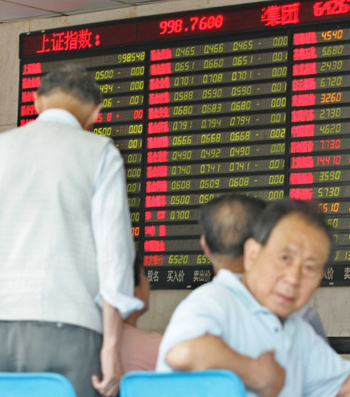
The leading stock index of Shanghai Stock Exchange, one of China's two bourses, once dropped to a low of 998.23 points during the morning session June 6, the lowest in nearly eight years.


Chinese investors look at an electronic board showing share prices at a securities company in Shanghai June 6, 2005. The Shanghai Composite Index fell below 1,000 at 11:03 Monday morning, the lowest since February 24, 1997. [newsphoto]

The composite stock index of the Shanghai bourse picked up slightly to 1,005.82 points at midday, but it was still lower than Monday's opening of 1,010.38 points.

The benchmark index covers yuan-denominated A shares and foreign-currency B shares.

On Friday, the benchmark Shanghai Composite Index, which covers both A- and B-shares listed on the Shanghai Stock Exchange, closed at a fresh eight-year low Friday, down 2.43 points, or 0.24 percent, at 1,013.64.

It was the lowest close since February 24, 1997 after three consecutive sessions of losses that saw the composite trim 3.8 percent of its value.

Dealers said they expect the index to fall through the key technical mark of 1,000 points soon unless Beijing steps in with strong medicine to cure broken investor confidence.

"The market has been falling for years and investors are numb," said Zhang Qi, analyst from Haitong Securities.

"The key is to recover investors' confidence. There is more that the government could do to better support investors in the market."

In April, Beijing tentatively moved to prop up the beleaguered exchanges to not just halt the financial hemorrhaging but also as a first stitch in a wound that has been festering for years.

The China Securities Regulatory Commission chose four companies under which the non-tradable shares would be listed, and then announced this week it would select 10 more.

But at both junctures, anxious investors responded with more selling.
"The sentiment was so weak that the index has been falling really fast. Some companies' stocks even lost all of last year's gains in these several sessions," said Zhang.

It was not the first time that regulators sought a solution to the parlous overhang, in which of the 1,200 listed companies Beijing owns 66 percent of the 3.52 trillion yuan (US$425 billion) of market capitalization.

Indeed it is these state holdings that has stopped cold the growth of China's bourses, quite the opposite of what would be expected in an economy that has been growing at more than eight percent for two decades.

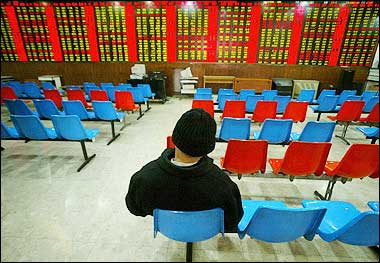
A man sits in front electronic stocks monitors in Shanghai. he future of China's deeply troubled stock markets went from bad to worse this week, slumping to fresh eight-year lows as regulators' plans to solve the overhang of non-tradable government-owned shares heightened fears more losses lie ahead.(AFP
A man sits in front electronic stocks monitors in Shanghai June 3, 2005. The future of China's deeply troubled stock markets went from bad to worse this week, slumping to fresh eight-year lows as regulators' plans to solve the overhang of non-tradable government-owned shares heightened fears more losses lie ahead. [AFP]


Regulators first tried to resolve the overhang of state shares in 2001 to raise funding for China's fledgling social security system but panicked investors sent stocks plunging, forcing authorities to abort the plan.

Since then, Beijing has repeatedly vowed to fix the problem but only soiled the wound by constantly balking at private and institutional investor demands that their interests be protected in any sale program.

The market last peaked at 2,245 points four years ago.

It was no surprise the markets continued an inexorable slide, said a Shanghai fund manager, refusing to be named.

"The market has been falling because the first batch of plans were really not that good. We don't think the next batch will be very good either," he said.
The reason China's stock markets are on the verge of collapse has to do with the original design and purpose of the exchanges.

Fifteen years ago, the central government in Beijing, looking for a way to avoid paying enterprises' heavy debts and fund a welfare system which once was the responsibility of chronically money-losing state-owned companies, struck on the idea of creating self-serving capital markets.

Under given quotas, provincial officials selected weak enterprises in hopes of clearing the mountains of debt built up in the days when workers were provided from the cradle to the grave by enterprises.

Although market players recognize that the state holdings must be disposed of, years of half-baked, non-committal government measures has made the average investor rightly suspicious.

"Investors couldn't help but doubt that this state shares sale plan is not something positive," said Yi Linming, analyst at Industrial Securities.

"And the more they doubted, the more the market panicked and the more the market panicked, the more they doubted," said Yi.

Now the overseer's slower and more-measured approach to push through reforms, while widely appreciated as necessary, remain under fire because investors complain that the government is looking out for its own interests only.

"What the investors need is compensation, and it is the government who should be responsible for it," said Yi.


  Today's Top News     Top China News
 

China's stock markets slumping to 8-year lows


Japan to scrap chemical arms left in China


Bank of China to seek strategic investors


Beijing Olympic volunteers get call-up


China-US talks fail to resolve disputes


Iraq says Saddam will face just 12 charges


  Beijing Olympic volunteers get call-up
   
  Disease threatens as more floods loom large
   
  China's stock markets slumping to 8-year lows
   
  Japan to scrap chemical arms left in China
   
  Many vote on names of pandas for Taiwan
   
  Community action turns the land green
   
 
  Go to Another Section  
 
 
  Story Tools  
   
  Related Stories  
   
China may cancel stock market dividend tax
   
Shares end at 6-year lows as textiles dive
   
China shares pick up from six-year low
   
Share flotation details announced
   
China to liquidate No 5 securities broker
   
Stock market slumps to 6-year low
   
1st unified index of bourses to be released
  News Talk  
  It is time to prepare for Beijing - 2008  
Advertisement
         
主站蜘蛛池模板: 漳浦县| 甘肃省| 丘北县| 济源市| 南乐县| 和静县| 奉新县| 内黄县| 太康县| 六枝特区| 琼结县| 腾冲县| 龙川县| 平原县| 怀集县| 高邮市| 宁晋县| 那曲县| 长岛县| 晋城| 新沂市| 镇巴县| 大宁县| 苍溪县| 巴青县| 平利县| 威宁| 虎林市| 安新县| 保定市| 陕西省| 吉木乃县| 安宁市| 老河口市| 格尔木市| 洞口县| 五寨县| 奉节县| 慈溪市| 桐柏县| 锡林浩特市| 施甸县| 赤城县| 栾川县| 潞西市| 特克斯县| 兴城市| 洮南市| 西青区| 芷江| 云南省| 定日县| 祁门县| 苗栗市| 洱源县| 会东县| 安顺市| 双牌县| 射阳县| 贺州市| 平阳县| 施秉县| 汉沽区| 嘉兴市| 浦县| 平江县| 于田县| 岢岚县| 南投市| 大同县| 依兰县| 汉沽区| 贵德县| 双桥区| 会同县| 卢龙县| 且末县| 延吉市| 神木县| 天津市| 靖江市| 衡南县|