|
Home>News Center>World | |
|
|
|
|
|
|
|
|
|
|
||||||||||||||||||||||||||||||||||||||||||||||||||||||||||||||||||||||
|
|
NASA space probe hits comet target
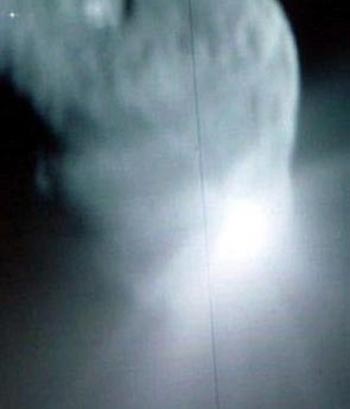
A space probe hit its comet target late Sunday in a NASA-directed, Hollywood-style mission that scientists hope will reveal clues to how the solar system formed. It marked the first time a spacecraft touched the surface of a comet, igniting a dazzling Independence Day weekend fireworks display in space. The successful strike 83 million miles away from Earth occurred just before 11 p.m. PDT, according to mission control at NASA's Jet Propulsion Laboratory in Pasadena, which is managing the $333 million mission.
Scientists at mission control erupted in applause and gave each other hugs as news of the impact spread. It was a milestone for the U.S. space agency, which hopes the $333 million experiment will answer basic questions about the origins of the solar system. The cosmic smash-up did not significantly alter the comet's orbit around the sun and NASA said the experiment does not pose any danger to Earth.
"We hit it just exactly where we wanted to," co-investigator Don Yeomans said. More than 10,000 people packed Hawaii's Waikiki Beach to see the impact on a giant movie screen. "It's almost like one of those science fiction movies," said Steve Lin, a Honolulu physician as his 7-year old son, Robi, zipped around his beach blanket. Scientists had compared the suicide journey to standing in the middle of the road and being hit by a semi-truck roaring at 23,000 mph. They expect the crater will be anywhere from the size of a large house to a football stadium and between two and 14 stories deep. A day earlier, the Deep Impact spacecraft successfully released its barrel-sized "impactor" probe on a high-speed collision course with Tempel 1 — a pickle-shaped comet half the size of Manhattan. After its release, the battery-powered probe tumbled in free flight toward the comet and flew on its own without human help during the critical two hours before the crash, firing its thrusters to get the perfect aim of the comet nucleus. A direct hit was a challenge because NASA's Jet Propulsion Laboratory no longer controlled the probe once it was released from the spacecraft. Even so, the odds favored success based on previous testing. Along the way, as the comet closed in, the copper probe took close-up pictures of the icy celestial body at a rapid clip until its destruction. The carefully orchestrated crash gave off energy equivalent to exploding nearly 5 tons of dynamite. The mothership had a front-row seat to the comet strike 5,000 miles away. NASA's fleet of space telescopes, including the Hubble Space Telescope, Chandra X-ray Observatory and Spitzer Space Telescope, and dozens of ground observatories also viewed the impact. Soon after the probe's crash on the comet's sunlit side, the mothership prepared to approach Tempel 1 to peer into the crater site and send more data back to Earth. The spacecraft planned to fly within 310 miles of the comet before it activates its dust shields to protect itself from a blizzard of debris. Comets are frozen balls of dirty ice, rock and dust that orbit the sun. A giant cloud of gas and dust collapsed to create the sun and planets about 4.5 billion years ago and comets formed from the leftover building blocks of the solar system. As comets circle the sun, their surfaces heat up and change so that only their frozen interiors possess original space material. Scientists hope to analyze images of these primordial ingredients jarred loose by the impact to give new insight into how the sun and planets formed. Deep Impact launched Jan. 12 from Cape Canaveral, Fla., on a six-month, 268 million-mile voyage toward Tempel 1. In what scientists say is a coincidence, the spacecraft shares the same name as the 1998 movie about a comet hurtling toward Earth. No other space mission has flown this close to a comet. In 2004, NASA's Stardust craft flew within 147 miles of Comet Wild 2 en route back to Earth carrying interstellar dust samples. The 1,300-pound spacecraft snapped its first photo of Tempel 1 from 40 million miles away in April, revealing what amounts to a dirty snowball. Last month, still 20 million miles away, scientists saw the comet's solid core for the first time.
|
|
|
|
|
|||||||||||||||||||||||||||||||||||||||||||||||||||||||||||||||||||
|
|
|
|
||||||||||||||||||||||||||||||||||||||||||||||||||||||||||||||||||||||