|
Space-age technology seeps into everyday life
By Sun Shangwu and Su Qiang (China Daily)
Updated: 2005-10-18 06:03
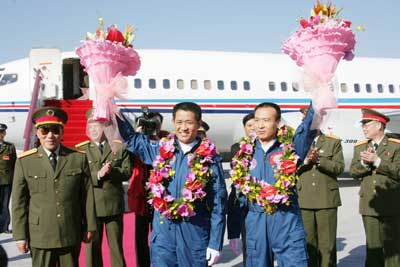
Astronauts Fei Junlong and Nie Haisheng ate, slept and read as comfortably
aboard Shenzhou VI as they do on terra firma because of space technology.
And that same technology has relevance to everyday life in China, which is
only one benefit from the space programme.
In 2003 when SARS (severe acute respiratory syndrome) threatened the lives of
hospital staff who were on the frontline in the fight against the deadly
disease, the Astronaut Centre of China played a role.
It designed a special cooling waistcoat based on its spacesuit technology so
that nurses and doctors wearing heavy anti-virus uniforms didn't have to be
tortured by high temperatures.
And people who want to filter out more words amidst noisy conditions can
thank audio technology in the spacesuit that helps them better understand a
speaker.
In the parade to celebrate the 50th anniversary of National Day in 1999,
communications between tank drivers and tank forces were constantly interrupted
until spacesuit headphones reduced extraneous noise effectively, said Li Tanqiu,
director of the spacesuit research office of the centre.
"The development of spacesuits involve nearly all technologies used for
preventive and protective purpose, and these technologies will have wider use in
other sectors," Li said.
Other technologies developed for space exploration are now a feature of
everyday life.
Beijing-based Outlook Weekly described some examples in its latest edition:
Digital cameras: Space scientists developed digital cameras in the 1960s to
transmit pictures from outer space to the earth using satellite signals. Japan's
Sony Company later developed the device into a consumer product.
Satellite technology: Satellite telecommunications has provided more than 100
kinds of service to human beings to improve such areas as phone calls, data
transmission, telecasts, televised education, mobile telecommunications, rescue
operations and medical data sharing.
Upgraded medical appliance: The image-enhancing techniques developed by US
scientists in the Apollo moon-landing programme have been used in the image
processing in medical equipment such as Computer Tomography and nuclear magnetic
resonance.
New materials: The special conditions of living in outer space, characterized
by microgravity, a need for cleanliness and being in a vacuum, provide an ideal
place for producing new materials.
Statistics show that of 1,100 kinds of new materials developed by China in
recent years, 80 per cent have benefited from space technology.
Dehydrated vegetables: If you eat instant noodles, you will find a small bag
of dehydrated vegetables in the package. That was produced during the Apollo
moon-landing programme to enable astronauts to eat vegetables in outer space.
Space breeding: Under the influence of space rays, the genes of crop seeds
carried by spacecraft were changed. As a result, some new crops with high yields
will be bred.
Incomplete statistics show that more than 800 kinds of seeds have undergone
in-space breeding experiments by retrievable satellites since 1987 in China.
Experiments show that these crops have made remarkable progress in producing
bigger fruit containing more nutrients and with a higher ability to resist
pests.
Outlook Weekly quoted Professor Han Liyan of the Beijing University of
Aeronautics and Astronautics as saying that every 10 yuan (US$1.23) invested in
the aerospace industry has generated 80-140 yuan (US$9.87-17.30) worth of
benefits.
China's direct investment in the sector has exceeded 10 billion yuan (US$1.23
billion) each year. The total scale of China's aerospace industry is now
estimated at 120 billion yuan (US$14.8 billion).
(China Daily 10/18/2005 page2)
|