|
Qualified Chinese economists no more than five?
By Hector Lee (mranti)
Updated: 2005-11-11 09:52
2005 is an eventful year for Chinese's mainstream economists, who have been
plunged into stern criticism both from the public and on the Internet.
Reflection on the current status of China's economics may lead to a retrospect
of China's reform and policy. Therefore China Business Times (CBT) had an
interview on Oct 26 with Professor Ding Xueliang, a sociologist from the Hong
Kong University of Science and Technology.
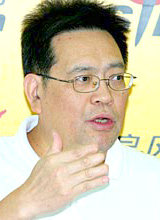
HK sociologist Ding
Xueliang with the HK University of Science and Techonology
[baidu] | CBT: During the past
two decades, it seems that only economists have been playing in the intellectual
arena, compared with other disciplines. They seem to have an exclusive edge to
affect our government's policy and become the limelight in the China's
opening-up and reform process. What's your comment on this?
Ding: In the past quarter century, we implemented our reform and policy
without considering sustainable development and a harmonious society. We always
stick to one subject and ignore others at the same time; this easily causes us
go astray. Some interest groups have emerged that are hard to ignore. The cost
will be expensive if we want to make things up.
During the past two decades, many people believed it was the economists'
responsibility to develop the economy, and economists were the only ones who
could speak out among the "silent majority." However, this is far from the
truth. In a mature and sustainable society, developing the economy is a
systematic project. Disciplines like law, sociology and political science all
play their own part in the policy-making process. Their impact may not be
overwhelming, but they cannot be replaced. Sociology focuses on social structure
and fairness. Law emphasizes procedure and justice. Political science concerns
the government's efficiency and cost. Each discipline has its own approach, so
there should not be a dominant discipline that muffles the others. You've seen
the English term "social studies?" The term is plural rather than singular. We
need different voices; we need dialogue and argument based on a normal
environment. Policy making should be a systematic project and should be made by
comprehensively understanding the essence of various disciplines.
CBT: How do you judge China's contemporary economics?
Ding: In those western countries whose economics are advanced and developed,
these disciplines are deeply professionalized, like physics and mathematics.
Their topics are professional and profound. How could economics become such a
communal discipline?
China's economics are too popular. Too many people claim to be economists,
and they dare to talk about everything. This means China's economics are still
young and far from being a serious discipline, let alone a science. True science
can't be so popular.
CBT: what do you think of the misleading policies made by economists, like
those in education reform?
Ding: Over a long period, a couple of so-called economic problems were not
real economics problems; they belonged to another area in international
practice. But experts from other areas were silenced while economists become
talkative. And since China's economics were still young, many un-economic
solutions and arguments which pretend to be economic led to more leeway in
policy-making.
CBT: During the past two years, more and more mainstream economists have been
blamed in public and on the Internet. How do you explain that?
Ding: This is complicated. One important reason is those mainstream
economists spend too much time on speaking for a certain interest group and too
little time studying. You can find many interest group spokesmen among Chinese
economists. Yes, it is true that there are also western economists who play such
roles, but they are few. And the most distinctive western economists never do
such things. They may be hired by banks and investment banks to study industrial
economics. Most so-called Chinese economists act like economic analyzers in a
western bank; they only speak for their employer's industry. But in terms of
professional quality, they cannot even be compared with an economic analyzer.
The best western economists are professors and researchers in top university
economics departments.
CBT: Are there any qualified economists in China?
Ding: I think there are no more than five. Some of the most famous Chinese
economists are not even qualified to be postgraduates in the world's top 50
economics departments. Some economists long for the Nobel Prize, but they
contribute nothing.
A real economist should make academic research the first priority,
not personal wealth, fame and rank. In western society, some economists become
officials in government and big banks, but only after they have made
distinguished and independent research achievements. And one day, they expect to
return to their original field and resume research. Wealth, fame and rank are
not their goals.
|