|
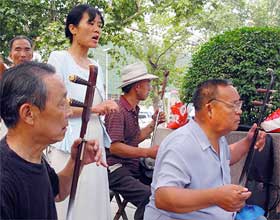
'Zile Ban' chanting ancient opera againt city wall
By Jeff (chinaculture.org)
Updated: 2005-11-16 15:27
While the charm of Xi'an usually originates from the grand ancient buildings
and its time-honored history, the city has much more. Qinqiang, a local opera
prevailing in Northwest China, represents the artistic height of the city's
attraction. Listening to as well as singing Qinqiang has become an important
part of many in the city. In the form of Zile Ban, Qinqiang has been exerting
its influence among the people, hence maintaining its vitality.
Zile Ban,
literally meaning self-entertaining class, usually consists of semi-professional
performers who were formerly amateur. No stage and lighting are required. With
only a few simple musical instruments, the performers stage the sorrows and joys
of life almost anywhere. Walking along the City Wall, one could easily find a
number of Zile Bans. With the sky as the curtain and earth as the stage, Zile
Ban is completely free in nature. Both the performers and the spectators are
very engaged into the program.
The amateur performers, who gather mainly in the form of Zile Ban, can be
frequently found under the ancient City Wall. They may come from distinctively
different walks of life, but yet share the same artistic hobby. They are also
all good at singing, or playing accompanying musical instruments. Despite their
amateur status, many of the participants are actually versatile.
The reason why Xi'an people love Qinqiang not only lies in the antiqueness of
the art form as a cultural relic. It's also because the snarling and screaming
style best echoes the desires and feelings of their souls.
The form of Zile Ban has greatly enhanced the dissemination and popularity of
Qinqiang Opera, which has become an indispensable part in the cultural scene of
Xi'an. Most of the local people can sing some lines of the opera, and almost
every village has its own Zile Ban. During major festivals like the Spring
Festival, the villagers indulge themselves to satisfy their addiction to the
opera art form.
There are several grandiose professional Qinqiang Opera troupes like the
famous Yisu Theater, where a number of opera masters gather. However, common
citizens don't quite frequent those places; instead, they more often participate
in or listen to Zile Ban along the City Wall.
With fervent love for Qinqiang, people from all ages in Shaanxi Province
favor the Qinqiang TV program. Among the dozens of TV stations and hundreds of
programs, Voice of Qin, a program promoting Qinqiang by the Shaanxi Provincial
TV Station, has been the audience-rating winner for more than ten consecutive
years.
When people from outside of Shaanxi Province observe the unique singing style
of Qinqiang Opera, especially that of the "painted face," they are usually
astonished by its intensity and exaltation, and jokingly summarize three
necessary requirements for the performance of Qinqiang: First, the stage must be
solid enough so that it would not collapse when the performers are singing;
second, the performers must be strong enough so that they won't tire out in
their long career; and third, the spectators must be bold and audacious enough
so that they won't be too scared to enjoy the performance. Though those words
may be a little exaggerative, they have in a way demonstrated the artistic
feature of the art form.
According to the historical records of the Qing Dynasty (1644-1911), Qinqiang
had been spread to all of China except the provinces in the northeastern part of
the country.
As a local opera mainly prevailing in Shaanxi and Gansu provinces, Qinqiang
Opera was formed in the Mid-Ming Dynasty (1368-1644). Kunqu, Yiyang tune, and
other local art forms have influenced it throughout its development. With wooden
clapper as the rhythm instrument, the music is loud, vehement, and sonorous, and
the opera excels in expressing majestic, angry, solemn, and stirring sentiments.
The art form disseminated across the country at the juncture of the Ming and
Qing (1644-1911) dynasties, exerting influences at different levels to a lot of
local operas in China, including Peking Opera.
|