|
US farmers use pesticide despite treaty
(AP)
Updated: 2005-11-28 09:30
Shoppers rifle through store shelves brimming with succulent tomatoes and
plump strawberries, hoping to enjoy one last round of fresh fruit before the
Western growing season ends. There is no hint of a dark side to the blaze of
red.
Strawberries are a painful subject for Guillermo Ruiz. The farm worker
believes his headaches, confusion and vision trouble stem from a decade working
in the fields with methyl bromide, a pesticide that protects the berries with
stunning efficiency.
Cheri Alderman, a teacher whose classroom borders a farm, fears her students
could inhale a dangerous whiff of the fumigant as it drifts from the adjacent
strawberry field. "A little dribble of poison is still poison," she says.
The concerns stretch globally.
Other nations watch as the United States keeps permitting wide use of methyl
bromide for tomatoes, strawberries, peppers, Christmas trees and other crops,
even though the U.S. signed an international treaty banning all but the most
critical uses by 2005.
The chemical depletes the earth's protective ozone layer and can harm the
human neurological system, an increasing concern as people settle further into
what was once just farm country.
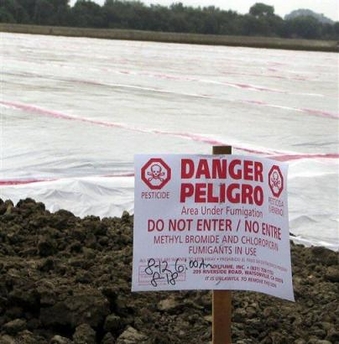
A sign, required by law, warns of a pesticide
application of methyl bromide on a field near Watsonville, Calif., Aug.
12, 2005. [AP] | Methyl bromide's survival
demonstrates the difficulty of banishing a powerful pesticide that helps deliver
what both farmers and consumers want: abundant, pest-free and affordable
produce.
The Bush administration, at the urging of agriculture and manufacturing
interests, is making plans to ensure that methyl bromide remains available at
least through 2008 by seeking and winning treaty exemptions. Also, the
administration will not commit to an end date.
The administration's "fervent desire and goal" is to end methyl bromide's
use, said Claudia McMurray, deputy assistant secretary of state.
The amount of the fumigant that the administration requested under treaty
exemptions for the next two years is lower than in 2005. Golf course sod, for
instance, won an exemption this year but not next.
"I can't say to you that each year the numbers (of pounds used) would
automatically go down," she said.
The reason is that farmers who each year grow Florida tomatoes, California
strawberries, Georgia peppers and North Carolina Christmas trees worth billions
of dollars are struggling to find a suitable replacement. Alternative organic
techniques are too costly and substitute chemicals are not as effective, growers
say.
"We're not totally clueless. We've seen this train coming. We've tried every
alternative and put every engine on the track, but none of them run," said
Reggie Brown, manager of the Florida Tomato Committee.
Odorless and colorless, methyl bromide is a gas that usually is injected by
tractor into soil before planting, then covered with plastic sheeting to slow
its release into the air. It wipes out plant parasites, disease and weeds. It
results in a spectacular yield, reduced weeding costs and a longer growing
season.
Workers who inhale enough of the chemical can suffer convulsions, coma and
neuromuscular and cognitive problems. In rare cases, they can die.
Less is known about the long-term effects of low levels of contact, said Dr.
Robert Harrison, an occupational and environmental health physician at the
University of California, San Francisco.
The U.S. signed the Montreal Protocol treaty, committing to phase out methyl
bromide by 2005 as part of the effort to protect the earth's ozone layer.
A provision allows for exemptions to prevent "market disruption." The U.S.
has used it to persuade treaty signers to allow U.S. farmers to continue using
the chemical.
That exemption process leaves the U.S. 37 percent shy of the phaseout
required by 2005, with at least 10,450 tons of methyl bromide exempted this
year. While that compares with about 28,080 tons used in 1991, this year's total
is higher than it was two years ago.
U.S. officials are heading to a Montreal Protocol meeting in Senegal on Dec.
7 to begin negotiations on exemptions for 2007 and are preparing requests for
2008.
|