|
Sweet sweat of making sugar
(China Daily)
Updated: 2004-03-16 08:56
Although he is soaked in sweat, Zeng Jurong cannot stop stirring the liquid in the big cauldron. It is 9 o'clock in the morning, but Zeng has already been at work for seven hours. He will be busy the whole day, to complete his job only when he has extracted the juice from 5,000 kilograms of sugar cane and made it into 500 kilograms of unrefined brown sugar.
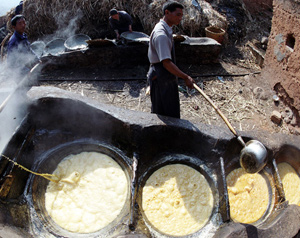
Villagers monitor the distillation process with great care. [China Daily] |
Zeng, 22, is just one of the 100 peasants of the village of Yaomi, in Chunjiang Township in Jinyang County, Southwest China's Sichuan Province, who have been taking turns doing the same work right through the Spring Festival holiday. Planting sugar cane has been an important part of the livelihood of the local farmers for over 200 years.
"We rely on sugar cane to supplement our incomes," says Liu Dayuan, the village head, in his 50s, who has just finished his stint at making sugar.
The village now has about 7 hectares of sugar cane fields, divided among the 44 households of the village, which is able to produce 500,000 kilograms of sugar cane every year.
Hard work
It is a busy time for the villagers when the sugar making season rolls around. The roaring diesel-powered extractor breaks the tranquility of the small village one month before the Spring Festival and the work usually goes on for about two months.
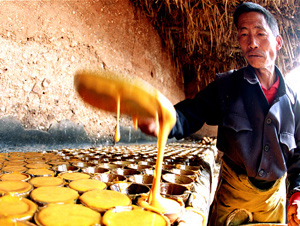
A villager pours the golden syrup into small bowls. When it cools, it hardens into bowl-shaped rounds of tasty brown sugar. [China Daily] |
The villagers have four specially built sheds for making sugar. They draw lots to establish their time to use the sheds.
Sugar making requires teamwork, so the villagers all help one another.
"Thirty people helped me cut the cane yesterday," said Zeng Jurong.
"Today I have 18 helpers, in addition to two skilled technicians," said the young man.
In the shed he is using there is a square collecting pool made of bricks and eight big cauldrons in a row, all of which are connected with plastic pipes. The sugar cane juice flows from the extractor into the brick-lined pool. After being allowed to settle for a while, the juice is channeled into the first cauldron for boiling. At a lower level than the big boiling cauldron, the other seven cauldrons, lined up in a row, are used in the distillation process leading to the final step - packaging the completed rounds of brown sugar. The first four cauldrons are all 1.66 metres in diameter, and the other three are smaller - about 90 centimetres in diameter.
Two men operate the diesel-powered extractor and two men tend the fire. Three women collect the sugar cane from which the juice has been extracted. They leave enough cane for fuel in the shed and carry the left-over canes back home to use for cooking.

A villager stacks the bowl-shaped sugar rounds into columns of 10 before wrapping them with dried cane leaves. [China Daily] |
The contents of each of the cauldrons are different in colour. The juice in the first one is thin, and contains a lot of impurities. Zeng Jurong, with a wooden dipper, removes the impurities putting them in a barrel. "This is used to feed our pigs," says Zeng.
Yao Yongqiang, one of the two skilled technicians, is responsible for boiling the sugar. "It's not easy to control the temperature," said Yao, who has been doing the work for more than 15 years. "You must know precisely the right time for every stage of the process: for instance, when to put the cooking oil into the cauldron," he said.
Standing beside the last three cauldrons was Zeng Fangpin, the other technician.
"I learned the process when I was only 12," said Zeng, 55, who is the village's "sugar master." With an apron around his waist, Zeng, holding a spatula in his left hand and a wooden dipper in his right, keeps filling the small bowls on the table with the golden syrup. "See, I can pour them exactly to weight," he said proudly.
But Zeng said that making sugar was really a hard job. "My waist and wrists usually ache after a day's work," he said.
Beside the table several men were busy taking the solidified rounds of sugar from the containers and wrapping them in stacks of 10 with dry sugar cane leaves.
"Each package weights 0.9 kilograms," said Zeng Jurong. "It's a handy size for marketing," said Zeng, who expects to make 500 kilograms of sugar this time.
Sales declining
Yaomi Village brown sugar is well known for its quality in the surrounding communities. It used to sell well in the late 1970s and the 1990s. But sales have been falling off perhaps because more and more people are cutting sugar from their diet for health reasons.
"I still remember the day when we bought the first diesel-powered extractor," said Liu Dayuan. The machine cost us 8,000 yuan (US$965), half of which was paid by the villagers, and the other half was paid with a loan from the township government. The new machine replaced their old, less efficient millstones
"We paid off the loan the next year," said Liu, adding that this was because the brown sugar was selling well at that time.
"In 1996 and 1997 one kilo of sugar sold for three yuan (36 US cents)," Liu recalled.
"It seems that people no longer like brown sugar," Liu said. He said that he produced 1,251 kilograms this year. Usually one kilo sells for 2 yuan (24 US cents). Now he has to trek 8 kilometres through the mountains to the Chunjiang township seat to sell his sugar. "I think it will take me the whole year to sell it all," said Liu, pointing at the piled-up packages of sugar. Before the rain season he will have to put them in plastic bags.
Because of the poor roads, the farmers can market their sugar only as far as the town seat.
"Fortunately, we don't need to worry about our staple diet," Liu said.
In 1998, the Chinese Government decided to turn cultivated lands bordering major rivers and lakes back into forest for environmental protection, and Yaomi Village, which is beside the Jinsha River, now gets a grain subsidy from the government.
The compensation plan provides them with 81.6 kilograms of rice and 21 kilograms of flour for every mu (15 mu equals one hectare) of cultivated land returned to forest.
"I get 1,060 kilos of rice and 273 kilos of flour every year," said Liu, who had 13.2 mu farmland by the river.
"We have more than enough to fill our stomachs. But we still need money for other necessities," said Liu. "Planting sugar cane and making sugar has long been our way out," he said.
The farmers are considering another way to make money - raising silkworms. "However, it takes time for the villagers to change their traditional way of living," Liu said.
|


