| Early last century, hundreds of thousands of Tibetan antelopes may have roamed the Qinghai-Tibetan Plateau; 20 years ago, their peaceful paradise, the Hoh Xil, was turned into a hunting ground by ruthless poachers.
After a hail of gun shots, flocks of Tibetan antelopes tumbled. Poachers immediately skinned them, dried the raw pelts in the sun, and smuggled them to India for processing.
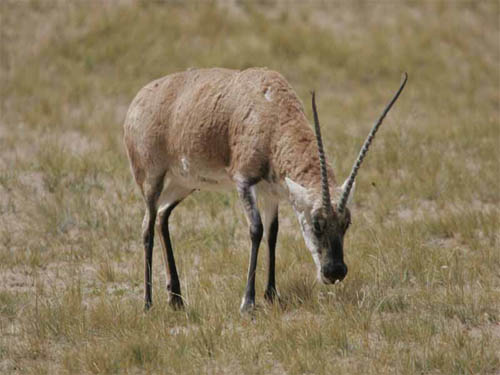
"Newly-born foals, murmuring piteously for food, staggered around the stiff corpses of their mothers, and tried to suck the breasts already skinned by poachers," Wang Zhoutai, a 46-year-old anti-poaching ranger recalled.
The Hoh Xil, China's largest uninhabited zone, lies on the Qinghai-Tibetan plateau which spans Qinghai, Tibet and Xinjiang.
It is home to Tibetan antelopes and another 230 species of rare wild animals, including Tibetan wild donkeys and wild yaks.
Tibetan antelopes were targeted by poachers because they produce the finest wool in the world, known as shahtoosh, a Persian word meaning "king of wool".
Each down hair of the Tibetan antelope is around six times thinner than the average human hair.
To make a shahtoosh shawl, incredibly lightweight and warm, takes the wool from three to four antelopes, and may fetch up to $11,000 US dollars on the global market.
Beginning in the late 1980s, shahtoosh shawls became a high fashion in Europe and the United States which fueled a black market and led to a slump in the population of Tibetan antelopes from 200,000 to 20,000 in 1997.
Tibetan antelopes have been given the highest level of protection under the United Nations' Convention on International Trade in Endangered Species since 1979, and listed among the most endangered species by the Chinese government since 1988.
Although hunting and the selling of Shahtoosh were stringently prohibited, poaching still prevailed in the Hoh Xil.
To curb the rampant slaughter of Tibetan antelopes, and save them from extinction, the Chinese government set up the Hoh Xil Nature Reserve in 1995, and upgraded it to a state-listed reserve in 1997.
The Nature Reserve, in the hinterland of the Qinghai-Tibet Plateau, covers 45,000-sq km with an average altitude of 4,600 meters.
In 2001, a Forestry Public Security Bureau was built to crack down poaching and the illegal trade in antelopes' fur in the Nature Reserve.
"It was an arduous task to combat well-armed poachers," said Buqon, director of the bureau.
Armed poaching gangs from Qinghai, Xinjiang and Gansu were often equipped with automatic weapons and tens of thousands of bullets, Buqon said. "If we fail to stop a poacher in time, thousands of antelopes would be killed."
To protect the fragile lives, rangers would cruise around their major habitats and watched out for poachers, often for several days and nights. "We just hope to seize them before they pull the trigger," Buqon said.
"For each patrol, guns and feeding bottles are our must-have," he said. "Guns are used to shoot the poachers, the other to feed the baby antelopes who just lost their mothers."
In the past eight years, the rangers have sent about 180 injured Tibetan antelopes and 120 other wild animals to the rescue center at the Nature Reserve.
They have also stopped eight armed poaching gangs, and saved the lives of tens of thousands of antelopes.
What the rangers struggled with were not only sly poachers, but also the adverse living environment.
"We have got used to eating and sleeping outdoors. It is no big deal," said Wang. "In the worst case, altitude sicknesses, such as acute pulmonary edema and brain edema, may kill us."
The patrol team consisted of 13 Communist Party members of ethnic Tibetan, Tu and Han groups.
When circling the hinterland, the rangers were frequently trapped in the wasteland by heavy snow or automobile breakdown.
"The longest time was 18 days," said Buqon. "After rescuers arrived, everyone walked out of the reserve with their mouths bleeding and swollen."
By August 2009, the rangers had conducted more than 300 patrols, covering 700,000 km. A total of 68 guns and more than 4,000 skins were impounded, said Cedain Zhou, director of the Hoh Xil Nature Reserve Administration.
The number of Tibetan antelopes in the Nature Reserve has climbed to 60,000, he said. |