 |
|
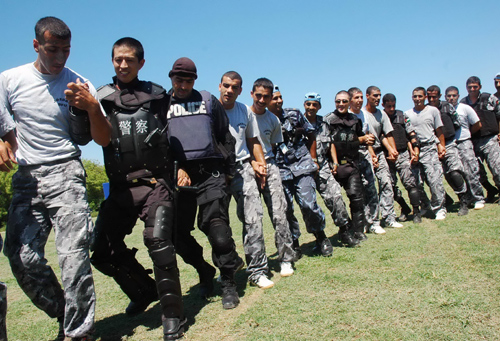
Chinese peacekeeping police join colleagues from around the world for a dance in Haiti. [Photo by Chen Jin/China Daily] |
Two Chinese officers share their experiences of serving the UN Stabilization Mission in Haiti before and after the quake. He Wei reports from Tianjin.
Two oceans and 13 hours separate China and Haiti. But as the sudden cholera epidemic and a turbulent election once again put Haiti under the international spotlight, two Chinese are especially - and personally -concerned with the developments. While Gao Zhihe and Liu Jinjin will spend the winter in chilly Tianjin municipality, images of steamy Port-au-Prince, Haiti's capital, linger in their minds.
"This has been one of the most dramatic and precious years of my life," 35-year-old Liu says.
Both officers say peacekeeping had captivated their imaginations for as long as they could remember.
This fascination finally led the two Tianjin Frontier and Inspection Bureau officers to take the ultra-competitive UN examinations to vie for two of the 17 available positions.
It was in 2009 when they learned they would be going to Haiti, a country roiling with civil unrest, health crises, environmental degradation and political instability.
Gao said he was "not at all worried for his safety" because the UN Stabilization Mission in Haiti (MINUSTAH) was going well, and his would be China's eighth contingent of civil police to the island nation.
But what Gao saw upon arrival defied imagination.
He hadn't been able to fathom the heat, or the endlessness of trash and muck that covered the streets. Potable water was extremely scarce. And it was a rare luxury to eat something as sophisticated as a hamburger or instant noodles.
UN officers also found themselves out of place among the locals. The language barrier - most Haitians speak the French pidgin Creole - was as great a hurdle to communication as their skin color was to acceptance by Haitians.
"We sometimes had to communicate in sign language. That's why I considered studying French at the UN's training center," Liu says.
Despite the hardships and dangers, life could be monotonously routine. They patrolled the streets and monitored the harbor from 8 am until 5 pm, drove long distances to work out in the Brazilian barracks and studied thousands of UN documents - that is, until the 7.0-magnitude earthquake in January 2010 changed everything.
The seismic violence left the country in shambles. Thousands of people lay dead or trapped inside the shantytowns' ruins.
Gao lost his roommate and his closest compatriot colleague.
He kept a diary that recorded his anxieties and mourning during the seven sleepless nights following the disaster. The officer kept waiting for the latest updates from mission head Zhao Huayu, who was later confirmed to have been crushed with seven other Chinese peacekeepers when the MINUSTAH headquarters collapsed.
The calamity changed their mission. Gao and Liu were quickly reassigned to guide the emergency rescue work of the government and aid groups.
It wasn't easy to watch survivors crouching along the streets, surrounded by heaps of debris and corpses. Many were bloody and didn't have food or water.
Limbs poked out of the jumbled shards of buildings, out of which poured a putrid stench.
The recovery was complicated by the destruction of Haiti's infrastructure, which was in dismal condition before the disaster.
But the two Chinese officers stayed calm, despite the horrific conditions and volatility of the masses. They viewed the reconstruction as a "rebirth".
"You simply don't have time to hesitate or be scared," Gao said.
"If you're lucky enough to survive the catastrophe, you have every reason to fulfill your duties by helping people lead normal lives."




Copyright 1995 - . All rights reserved. The content (including but not limited to text, photo, multimedia information, etc) published in this site belongs to China Daily Information Co (CDIC). Without written authorization from CDIC, such content shall not be republished or used in any form. Note: Browsers with 1024*768 or higher resolution are suggested for this site.
License for publishing multimedia online 0108263 Registration Number: 130349