Imperial Tombs of the Ming Dynasty
Updated: 2007-06-11 08:58 Despite the Ming Dynasty having ended under the rule of Emperor Chongzhen, neither the rebels nor the Manchurians who suppressed them to establish the Qing Dynasty thought ill of him, or disrespected his memory. He was, on the contrary, considered a capable and upright emperor, but scapegoat for the misdemeanors of his two predecessors. Prior to Chongzhen, Emperor Shenzong had ruled for 48 years, but for the last two decades of his reign had played hermit and neglected his duties. Shenzhong's successor, Emperor Xizong, had no interest in state affairs, preferring to work at carpentry. He filled the role of "emperor carpenter," and left state affairs in the evil hands of his wet nurse, Ke, and a eunuch named Wei Zhongxian. On ascending the throne, Chongzhen was faced with turbulent domestic difficulties as well as troubles on the border. However, he did his utmost to save the dynasty, and within three months of his enthronement, had executed and ousted hundreds of Ke's and Wei's followers. He also recalled formal officials, one in particular being Xu Guangqi, a great scientist, and the first in China to introduce Western science and technology. Chongzhen ruled for 17 years and worked energetically and conscientiously. However, his reign was ill-starred. When the rebels finally came, he neither escaped nor surrendered, but killed himself in self-abasement and remorse - a very rare act for an ancient ruler.
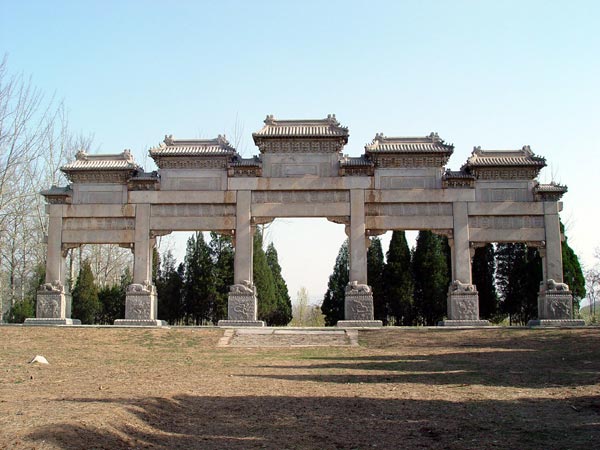
Tailing and Kangling Mausoleums
Some of the 13 Ming tombs, such as the Changling and Dingling mausoleums, have been repaired, and are popular tourist destinations. The Changling Mausoleum lures tourists for being the largest and best preserved of the tombs, while the Dingling Mausoleum provides a fascinating view of ancient relics both above and under ground.
The Tailing and Kangling mausoleums, located in the northernmost area of the site, are rarely visited. Owing to a lack of repair, they are, within the tall green pines that have guarded them through the ages, in ruins, their surrounding walls having mostly collapsed into debris. Only the golden dragons atop the yellow glazed tiles signify the special status of the tomb occupants, as the color yellow and dragon images were for the exclusive use of the imperial family.
The hall foundations are hidden in wild grass, and sections of carved marble balustrade lie here and there. Although the originally white marble has turned dark-gray, its exquisite carving and jade-like texture is still perceptible. The tomb bricks, contributed by various localities, are huge, each weighing over 20 kilograms. There were strict requirements regarding the quality of these bricks. They had to be fine and solid in texture, producing a resonant tone when tapped, and bearing the date of their production and locality. The Kangling Mausoleum bricks clearly show this information, being marked, "Made by Zhangqiu County in the seventh month of the 17th year of the Chenghua Reign (1481)," or "Made by Linqing Prefecture in the 10th year of the Zhengde Reign (1515)."
Both the memorial tower and Treasure City of these two tombs are still standing, albeit with a few tiles missing, exposing the weathered, rusty colored wooden roof bracketing. The five sacrificial utensils, now yellowish with age, are arranged neatly on a stone table before the memorial tower.
These two tombs belong respectively to the father and son, Emperor Xiaozong
and Emperor Wuzong. Xiaozong was the ninth emperor of the Ming Dynasty. He was a
benevolent, hard-working and competent ruler and created a period of peace and
prosperity. His success as a ruler may have been tempered by his lamentable
childhood. His father, Emperor Xianzong, was a mediocre emperor and concentrated
all his attention on the mean and malicious Concubine Wan, who was 19 years his
senior. Having lost a son when she was young, she bore no more children. To
protect her privileged status with the emperor, she placed her spies in various
corners of the inner court. If another concubine should be discovered to be
pregnant, Wan would force an abortion on her. When Xiaozong's mother was
pregnant with him, she was also made to take an abortion drug, but Xiaozong
miraculously overcame the drug, and lived.
 | 1 | 2 | 3 | 4 |  |