Eating Organic, Cooking Organic
 |
|
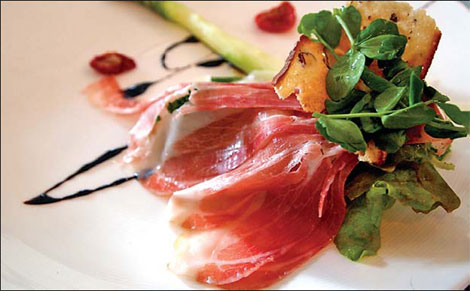
The appetizer revolves around the organic ham from the little black pigs of Yunnan's Lijiang area. Photos by Pauline D. Loh / China Daily |
 |
|
The pumpkin soup is a feast for both eyes and palate. |
 |
|
The organic shanzha palette was a creation by sous chef Liu for that final sweet note. |
While "organic" has become just another buzzword for some, there is a chef in Beijing who actually lives the lifestyle. Irene Deng talks to Christian Hoffman, the Swiss chef at Grace Beijing Hotel.
Christian Hoffman lives near the China World Trade Center, but he cycles to the 798 Arts district in East Chaoyang for work. He believes in an eco-friendly lifestyle, and he cooks and eats that way as well.
That was why he was so enthusiastic when China Daily approached him to design an organic dinner for its readers' club that will use the produce of Beijing's organic farmers.
Despite his strong Nordic features, the 46-year-old chef is shy and blushes easily, especially when being interviewed. But when the topic turns to food, especially fresh ingredients, he gets excited.
"We prefer to use products that look nice and have flavor. But if the vegetables only look beautiful, or are big in size but have no flavor, we don't use them, " says the chef.
Flavor and quality are the Swiss chef's guidelines when picking produce for his kitchen. He usually goes to markets and visits farms, tasting vegetables on the spot to judge their quality. When Hoffman went to the organic De Run Wu farm to verify ingredients for the organic dinner, he was like a child in a candy shop, getting ecstatic over the vegetables, and sniffing deeply at the deep rich earthy smell of soil.
"If we eat, we need to know how it grows. Organic is not about size but flavor. It takes time to grow, to meet nature," says Hoffman. "Things that are big can grow very fast. But flavor is the sunshine, it's from the soil. Vegetables need time to become tasty. So fast is not always good. It's the same with fish, the same with meat."
Next to taste and quality is eating according to season.
Hoffman may also use products that are not organic, but seasonal.
"It's very nice to see those farms that may not be organic, but grow what is in season," says the chef.
Hoffman's love for fresh ingredients can be traced back to his hometown in Davos, a small town in the Swiss Alps, where his family live on an 18-acre (7-hectare) farm on the mountain.
His father supported the whole family with their farm, keeping cows, pigs and harvesting timber from their little wood.
Hoffman's mother, a housewife who the chef describes as "the best home chef", exerted her influence on her three sons. Two are now chefs while one stayed home to run the farm.
At the young age of 15, Hoffman became an apprentice in a hotel at Davos, the starting point of his career. He learned everything in the kitchen - from soup to meat to dessert to sushi - and rose from kitchen hand to sous chef, and finally executive chef.
He spent eight years working on cruise ships, an experience which made him fall in love with seafood and Mediterranean cuisine, both of which gradually became incorporated into the Hoffman style.
"The menu he designs is very healthy, low in fat and light in taste, " says Liu Peng, sous chef at Grace Beijing Hotel. Liu has worked with Hoffman for five years. "You see, we are both very slim, and that's the result of how we eat - Mediterranean style, a very light and healthy diet," the tall 33-year-old Beijinger quips.
In the little garden behind their kitchen, Hoffman and his kitchen staff grow herbs like rosemary and arugula, little pumpkins and the like, many of which grew from seeds brought back from Switzerland by the chef.
"The taste of the herbs we grow is much stronger, very different from that bought in the market," says Liu.
Liu says Hoffman is very strict about the quality of ingredients used in his kitchen. Hoffman always tries the product first and judge whether it is good enough to be used.
Having been in China for 15 years now, Hoffman enjoys the life here. He likes the new things coming out everyday and new restaurants springing up everywhere. The fact that Chinese chefs are now cooking Western cuisine a lot better also makes him happy.

"In China, everything is on rise. It's nice to be part of the growth. When I first came here in 1996, people knew little about Western cuisine. After some years working with them, these Chinese chefs have become very good, even better than me. It makes me happy to see them make progress," Hoffman says.
For the China Daily's readers' club dinner tomorrow, Hoffman worked with Liu in designing the special "organic and sustainable" menu.
"We want to offer an interesting menu, use as many organic products as we can find in Beijing and follow the season. But for organic meats, it's most difficult to find in Beijing," the chef says.
The chef's appetizer will revolve around the organic ham from Yunnan's Lijiang area, where the little black pigs wander freely on the mountains drinking spring water and grazing on herbs and wild mushrooms.
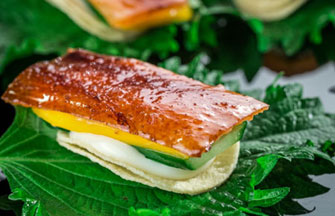
The next course is soup made from little organic pumpkins from De Run Wu farm. The grilled mackerel is from New Zealand, and the beef from Tasmania, the little island on the southeastern tip of Australia known for its clean air and unpolluted waters.
For dessert, the chefs returned to Beijing for inspiration. The organic shanzha or hawthorn palette is a creative combination of East and West, combining ideas from chef Hoffman and chef Liu.
"It's winter in Beijing now. There are no fruits in season except shanzha, the preserved haws from Beijing's hilly suburbs," says Liu. He once took Hoffman out to taste the most popular sweet in Beijing - bingtang hulu - the candied haw fruits on skewers. Both chefs think the final sweet note will make the diners very happy.
"Desserts made with chocolate can be cloying and heavy after a large meal. But the tartness of shanzha will make them happy," adds chef Liu.